
How to Get a Community Association Management License in Florida

To get a community association management license in Florida, complete 16 hours of state-approved education, submit fingerprints and an application to the Florida Department of Business and Professional Regulation (DBPR), then pass the state exam. You must be at least 18 and have a Social Security number. A license is generally required when you are paid to manage a residential association with more than 10 units or an annual budget over $100,000.
Most steps can be completed online, but you must take the exam at an authorized test center.
I'm Cédric Rose, founder and property manager at Management 305. My 14-plus years in residential property operations and community association management inform this guide to community association management license florida requirements.
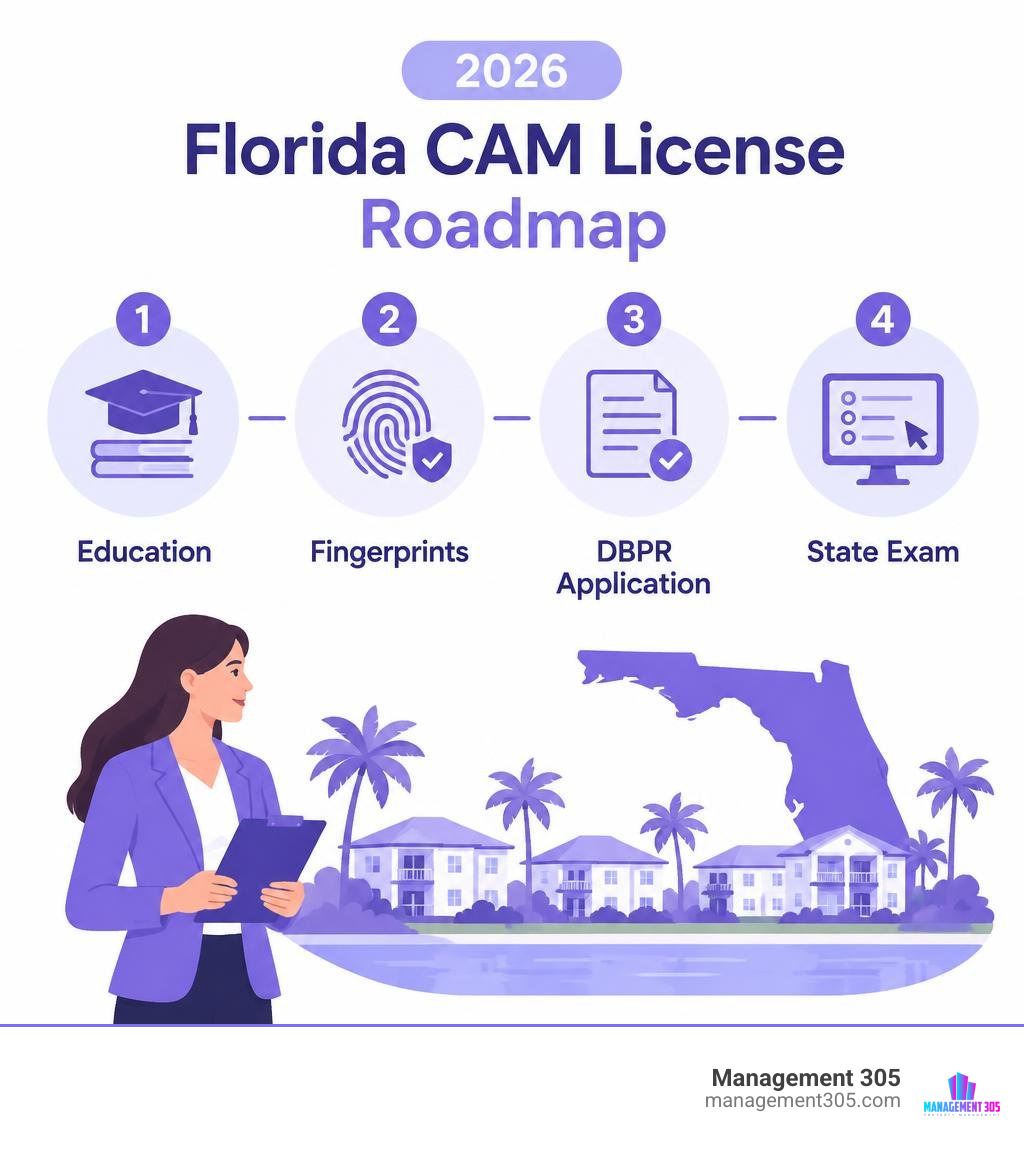
Requirements and Legal Scope for Florida CAM Licensure
Florida is home to thousands of residential condominium buildings, homeowners associations (HOAs), cooperatives, and planned unit developments. To safeguard the financial assets and physical health of these residential communities, the state enforces strict regulatory oversight through the Florida Department of Business and Professional Regulation (DBPR) and the Regulatory Council of Community Association Managers.
The statutory framework governing this profession is established primarily under Part VIII of Chapter 468 of the Florida Statutes. This legislation works directly alongside substantive residential property laws, including Chapter 718 (The Condominium Act), Chapter 719 (The Cooperative Act), and Chapter 720 (The Homeowners' Association Act). Operating residential communities across South Florida—whether in Miami, Sunny Isles Beach, Aventura, or Fort Lauderdale—requires navigating these statutes carefully to ensure board decisions, financial accounting, and day-to-day operations remain fully compliant.
Our team specializes in full-service condominium and HOA management services, and we understand that obtaining a license is not merely about passing a test. It establishes the baseline legal competence required to protect residential communities and their boards from costly liability and operational missteps.
When Is a Community Association Management License in Florida Legally Required?
Under Section 468.431 of the Florida Statutes, an individual is legally required to hold an active CAM license if they perform community association management services for remuneration (financial compensation) for any residential community that meets either of the following statutory thresholds:
- The community association contains more than 10 residential units.
- The community association operates with an annual budget exceeding $100,000.
If an association meets either criterion, anyone who manages its operational or financial affairs for pay must be licensed. The statutory scope of community association management includes:
- Controlling or disbursing association funds
- Preparing operating budgets or other financial documents
- Coordinating and sending official notices for board and membership meetings
- Conducting association meetings
- Negotiating vendor contracts and supervising common-area maintenance
- Determining the number of days required for statutory notices and statutory compliance
Unlicensed individuals who perform these tasks for pay face regulatory penalties from the state. For residential communities evaluating their administrative setup, our comprehensive community association management guide provides deeper context into how these statutory responsibilities function in everyday neighborhood governance.
Eligibility Criteria for a Community Association Management License in Florida
The baseline qualifications to obtain an individual Florida CAM license are straightforward, but every applicant must satisfy state standards:
- Age Requirement: You must be at least 18 years old.
- Identification: You must hold a valid United States Social Security Number (SSN).
- Work Authorization: You must have legal authorization to work in the United States.
- Residency Status: Florida residency is not required. You do not even need to be a U.S. citizen, provided you are legally authorized to work in the country.
- Good Moral Character: Applicants must undergo a comprehensive criminal history background check. Any past criminal convictions, guilty pleas, or disciplinary records from other professional licensing boards must be disclosed on the application for review by the DBPR.
Step-by-Step Guide to Getting a Community Association Management License in Florida

Navigating the licensing process is a linear journey. The DBPR allows you to complete education and background checks concurrently to streamline your timeline. Most candidates complete every requirement within three to five weeks.
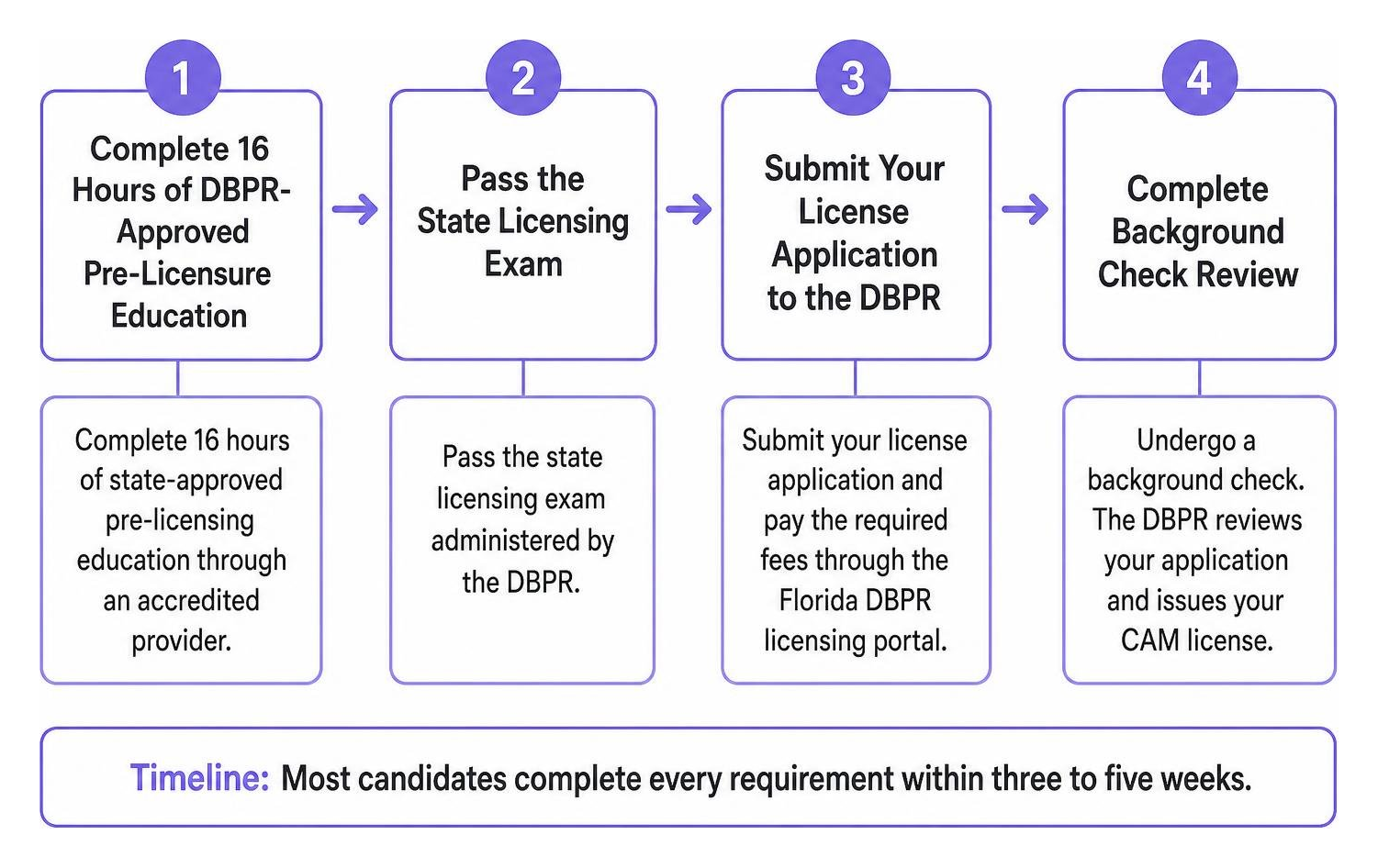
Here are the four essential steps to obtain your license through the official Florida DBPR licensing portal.
Step 1: Complete 16 Hours of DBPR-Approved Pre-Licensure Education
Before applying for your state exam, you must complete 16 hours of state-approved pre-licensing education through an accredited provider. This curriculum is designed to teach the operational and statutory essentials of Florida community management, covering:
- Florida Statutes Chapters 468, 718, 719, and 720
- Association financial accounting, assessment collections, and reserve funding
- Board governance, elections, and parliamentary procedures
- Maintenance coordination, vendor bidding, and contract oversight
- Insurance requirements, disaster preparedness, and risk management
Pre-license courses can be taken online, via interactive livestream, or in an in-person classroom setting. Once you complete the 16 hours, your education provider will issue an official Certificate of Completion. Keep this document safe: your pre-licensing certificate is valid for exactly one year from the date of issuance. You must apply for and pass the state exam before that one-year window expires.
Step 2: Complete Electronic Fingerprinting and Background Screening
Florida requires all CAM candidates to submit electronic Livescan fingerprints for state (FDLE) and federal (FBI) criminal background checks.
To complete your fingerprinting:
- Schedule an appointment with an authorized Livescan vendor (such as IdentoGO).
- Provide the specific Originating Agency Identification (ORI) number for Florida CAM licensure: FL921932Z.
- Retain the Transaction Control Number (TCN) provided on your fingerprint receipt. You may need this number if the DBPR requires verification while processing your application.
Fingerprint results are transmitted directly to the DBPR electronically. It is best to complete this step within a week of submitting your application so background results align smoothly with your state file.
Step 3: Submit the CAM 1 Application to the DBPR
With your pre-licensing education complete (or underway) and fingerprints submitted, you must submit the official Initial License by Examination application (Form CAM 1) through the Community Association Managers and Firms portal on the DBPR website.
During submission, you will:
- Provide personal background details, contact information, and your Social Security Number.
- Answer statutory background questions regarding criminal history or past professional license actions.
- Upload your 16-hour pre-licensure course completion certificate.
- Pay the state application processing fee.
The DBPR reviews applications in the order received, typically taking 7 to 14 business days. Once approved, the DBPR issues your Florida Real Estate Application ID (FLREAPP ID) and authorizes you to schedule the state exam.
Step 4: Schedule and Pass the Pearson VUE State Examination
The Florida CAM examination is administered by Pearson VUE, the state’s computer-based testing vendor. Tests can be scheduled at any authorized Pearson VUE testing center across Florida or nationwide.
The examination tests your understanding of association operations, meeting procedures, financial management, physical property oversight, and Florida statutes. Reviewing the official DBPR Candidate Information Booklet prior to test day will give you a clear breakdown of weighted exam categories.
Upon completing the test, you receive your score report immediately at the testing center. If you pass, Pearson VUE transmits your passing score to the DBPR, and the state issues your active license number shortly afterward. If you do not pass on your first attempt, you may reschedule and retake the test after a mandatory 24-hour waiting period by submitting an exam retake request (Form CAM 3).
Florida CAM Licensing Costs, Firm Classifications, and Renewal Rules
Starting your career in residential association management requires planning for initial licensing expenses as well as recurring biennial renewal obligations. Additionally, individuals who plan to run their own management businesses must understand the difference between individual licenses and firm licenses.
Working with experienced professionals who maintain active professional management credentials guarantees that a residential community's administrative and financial operations adhere to the highest industry standards.
2026 Florida CAM Licensing Cost Breakdown
The total cost to acquire your initial license generally falls between $485 and $675, depending on your chosen course provider and fingerprinting location.
| Expense Item | Purpose | Estimated Cost |
|---|---|---|
| 16-Hour Pre-License Course | State-mandated training from approved provider | $180 – $340 |
| Electronic Fingerprinting | FDLE & FBI background check (ORI: FL921932Z) | $50 – $80 |
| DBPR Application Fee | State processing and licensing fee (CAM 1) | $205.50 |
| Pearson VUE Exam Fee | Computer-based testing center administration | $49.50 |
| Total Estimated Initial Investment | Complete pathway to initial licensure | $485 – $675 |
Note: The DBPR provides initial licensing fee waivers for active-duty military personnel, veterans, military spouses, and qualifying low-income applicants.
Individual CAM License vs. CAM Firm (CAB) License
In Florida, an individual license allows a person to provide management services. However, if you establish a company entity that contracts directly with residential associations to provide management services, the entity itself must hold a Community Association Management Firm (CAB) license under Section 468.432, Florida Statutes.
| Feature / Requirement | Individual CAM License | CAM Firm (CAB) License |
|---|---|---|
| License Designation | Individual Manager (CAM 1) | Management Company / Entity (CAM 2) |
| Application Requirements | 16-hr course, fingerprints, state exam | Registered business entity, licensed CAM in direct charge |
| Who Must Hold It? | Any person managing associations for pay | Any corporate entity contracting to provide CAM services |
| Renewal Deadline | September 30 of EVEN years | September 30 of ODD years |
| Biennial Renewal Fee | $105.00 | $105.00 |
| Continuing Education (CE) | 15 hours every 2 years | None (individual managers fulfill CE requirements) |
Biennial License Renewal and Continuing Education (CE) Rules
Individual Florida CAM licenses expire on September 30th of every even-numbered year. To maintain an active license, managers must submit their renewal through the DBPR portal, pay the $105 renewal fee, and complete 15 hours of DBPR-approved continuing education (CE) during each two-year cycle.
The 15-hour curriculum must be distributed across specific statutory subject areas:
- 3 Hours: Legal Update (recent statutory changes in Florida property and association law)
- 3 Hours: Insurance and Financial Management
- 3 Hours: Operation of the Community's Physical Property
- 3 Hours: Human Resources and Disaster Preparedness
- 3 Hours: Approved Electives
Furthermore, managers who provide management services to homeowners associations must ensure that at least 5 of their 15 CE hours are directly related to HOAs, with at least 3 hours specifically dedicated to association recordkeeping.
Frequently Asked Questions About Florida CAM Licensing
Can I get a Florida CAM license entirely online?
Most of the licensing journey can be completed online from your home or office. You can take your 16-hour pre-licensing education course online, submit your initial CAM 1 application and documentation through the DBPR Online Services portal, and schedule your testing appointment via the Pearson VUE website.
However, you must sit for the actual 100-question computer-based exam in person at an authorized Pearson VUE testing center. Pearson VUE operates test centers across Florida and throughout the country, allowing out-of-state candidates to test locally before relocating.
What is the difference between an individual CAM and a CAM Firm (CAB) license?
An individual CAM license is issued to a specific person who has satisfied state education, background, and examination requirements. This allows that individual to legally deliver community management services.
A Community Association Management Firm (CAB) license is issued to a business organization (such as a corporation or LLC) that contracts with associations to provide management services. A CAB firm must designate a licensed Florida CAM who is actively responsible for supervising the firm’s management activities. When associations evaluate local HOA management companies, verifying that both the firm and its individual managers hold active DBPR licenses is essential for compliance and peace of mind.
What activities are exempt from CAM licensing in Florida?
Under Florida law, individuals who perform purely clerical, ministerial, or routine physical maintenance duties are not required to hold a CAM license, provided they work under the direct supervision of a licensed manager or the association's board of directors.
Exempt activities include:
- Receptionist duties, answering phones, and processing gate access passes
- Routine grounds maintenance, pool servicing, janitorial work, and physical repairs
- Data entry and bookkeeping tasks that do not involve controlling or disbursing funds or drafting official budgets
- Taking meeting minutes under the direction of an association secretary or licensed CAM
Any task that crosses into interpreting governing documents, preparing official budgets, issuing statutory meeting notices, or disbursing association funds requires an active CAM license.
Conclusion
Securing your Florida CAM license requires dedication, structured study, and a clear understanding of state statutes. For residential condominiums and homeowners associations across South Florida—from Miami and North Miami Beach to Hollywood, Dania Beach, and Fort Lauderdale—partnering with licensed, highly trained community managers is the surest way to safeguard property values, maintain reserve funds, and run peaceful, well-ordered communities.
At Management 305, we combine proactive, boutique-style attention with modern, technology-enabled oversight to deliver transparent residential property management and association administration. Whether you are a board member seeking dedicated management support or looking to elevate your community's operations, contact our team today to discover how our experienced residential professionals can support your neighborhood.
