
What Homeowner Association Property Management Companies Do vs. The Board

To find and evaluate qualified homeowner association property management companies, boards should verify state Community Association Manager (CAM) licensing, audit manager-to-property portfolio ratios, inspect real-time digital portals, and confirm fee and vendor contract transparency. Evaluating these core pillars ensures your association secures reliable operational execution while protecting community assets.
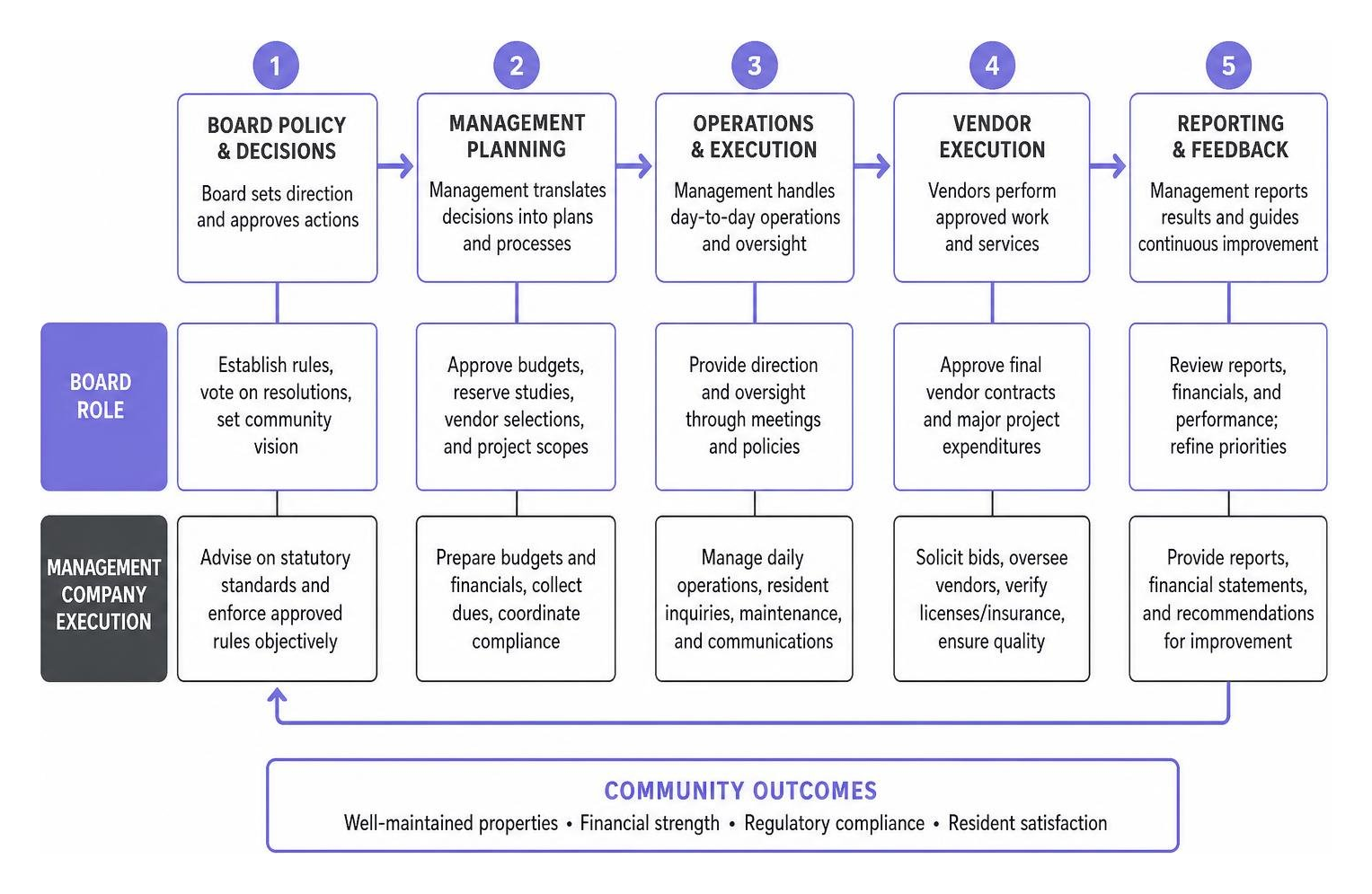
Under Florida law, the board of directors retains ultimate fiduciary duty and decision-making authority. The board votes on policies, adopts the annual budget, approves major contracts, and interprets the community’s governing documents. In contrast, partnering with a licensed CAM Community Association Management firm ensures that those decisions are carried out smoothly every day. We act as the operational arm of the board, executing directives, managing daily resident interactions, and ensuring physical residential property assets remain in peak condition.
| Responsibility Area | Volunteer HOA Board Duties | Management Company Execution |
|---|---|---|
| Governance & Policy | Establishes rules, votes on resolutions, and sets community vision | Advises on statutory standards and enforces approved rules objectively |
| Financial Oversight | Approves annual budgets, reserve studies, and special assessments | Prepares monthly financial statements, collects dues, and manages disbursements |
| Vendor Management | Selects vendor proposals and approves final project scopes | Solicits competitive bids, oversees contractors, and verifies licenses/insurance |
| Maintenance & Assets | Decides long-term capital improvement priorities | Conducts regular property walks, schedules preventative repairs, and manages common areas |
| Resident Communication | Conducts formal board meetings and annual elections | Operates digital homeowner portals, logs work orders, and answers daily inquiries |
Administrative and Financial Operations
Sound financial health is the bedrock of any thriving residential community. When boards manage operations without professional support, routine accounting can turn into a source of stress.
We take over routine administrative tasks, ensuring that dues collection is handled consistently and according to statutory timelines. This includes:
- Managing assessment receivables through dedicated, real-time owner portals.
- Preparing timely monthly balance sheets, income statements, and budget-versus-actual variance reports.
- Overseeing operating and reserve accounts with Florida-compliant handling.
- Coordinating annual audits, tax filings, and reserve study updates to keep long-term repair funds fully solvent.
By automating dues collection and offering transparent digital access, boards gain clear insight into their community's financial health without tracking down neighbors for late payments.
Maintenance, Vendor Coordination, and Compliance
From swimming pool chemistry and elevator inspections to landscaping, irrigation, fire safety, and waste management, maintaining residential common elements requires constant attention.
We maintain a vetted network of insured, licensed contractors and service providers across South Florida. Instead of board members spending their weekends meeting contractors, our team handles:
- Drafting detailed scopes of work and securing competitive bids.
- On-site representation and quality control for repairs, maintenance, and capital renovation projects.
- Managing code compliance, scheduled inspections, and city violation remediation.
- Routine community walks to enforce Covenants, Conditions, and Restrictions (CC&Rs) uniformly, removing personal bias from architectural reviews and rule enforcement.
Signs Your Board Needs Professional HOA Management
Many residential communities begin as self-managed associations when they are newly developed. However, as properties age and regulatory requirements become more stringent, self-management can become unsustainable.
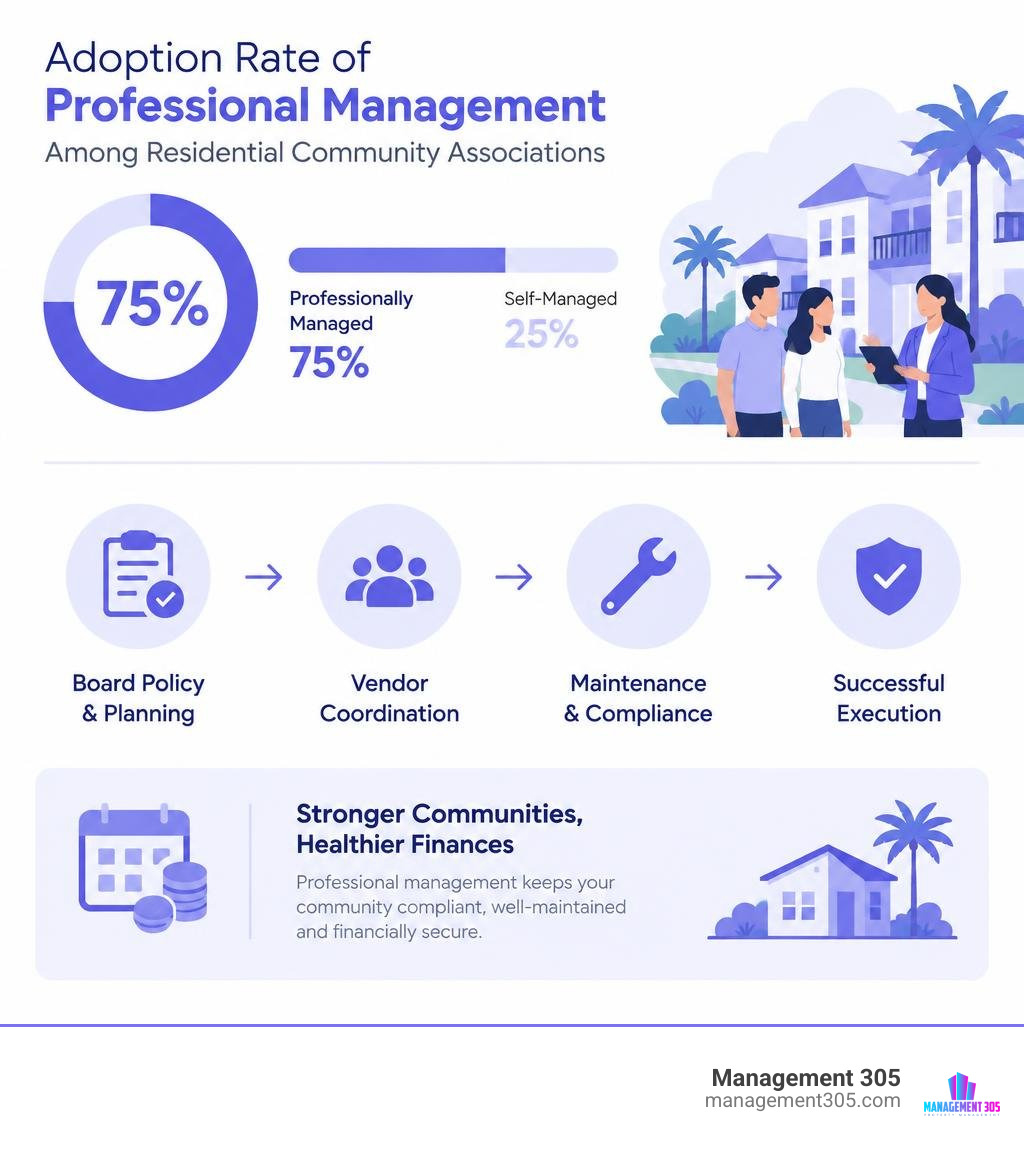
If your board is experiencing friction, missed deadlines, or declining curb appeal, it may be time to explore our blog on local HOA management companies to understand how professional oversight restores balance. Nationwide, approximately 75% of homeowner associations rely on professional management companies to maintain compliance and protect their investments.
Overwhelmed Volunteer Hours and Delayed Projects
Board members often find themselves spending 10 to 20 hours per month on association tasks. When volunteers balance full-time careers and family commitments, critical community projects can stall.
Key operational warning signs include:
- Maintenance requests sitting unresolved for weeks, leading to deferred repairs and higher eventual costs.
- Difficulty finding residents willing to serve on the board due to the heavy workload.
- Board meetings stretching late into the evening debating minor maintenance tasks rather than strategic planning.
- Inconsistent communication that leads to homeowner frustration and contentious annual meetings.
When community maintenance turns into a second, unpaid full-time job, professional management steps in to give directors their personal time back.
Escalating Dues Delinquencies and Financial Complexity
Managing accounts receivable requires strict consistency and compliance with state collection laws. When board members are forced to collect overdue assessments from their immediate neighbors, personal relationships can complicate fiduciary responsibilities.
Rising delinquency rates directly harm cash flow, often forcing associations to defer essential preventative maintenance or impose surprise special assessments. Professional CAM firms institute structured, automated collection notices, apply late fees in accordance with your bylaws, and work seamlessly with association legal counsel when formal collections or liens become necessary.
How to Evaluate and Hire the Right Management Partner
Selecting the right partner requires a clear look at your community’s specific architectural profile, amenity load, and historical pain points. Rather than looking for the cheapest vendor, boards benefit most by focusing on cultural fit, local presence, and administrative transparency.
If your community includes single-family homes, luxury condominiums, or boutique townhome enclaves, exploring our foundational blog on property management can help frame the evaluation process.
Evaluating Top Homeowner Association Property Management Companies for Your Community
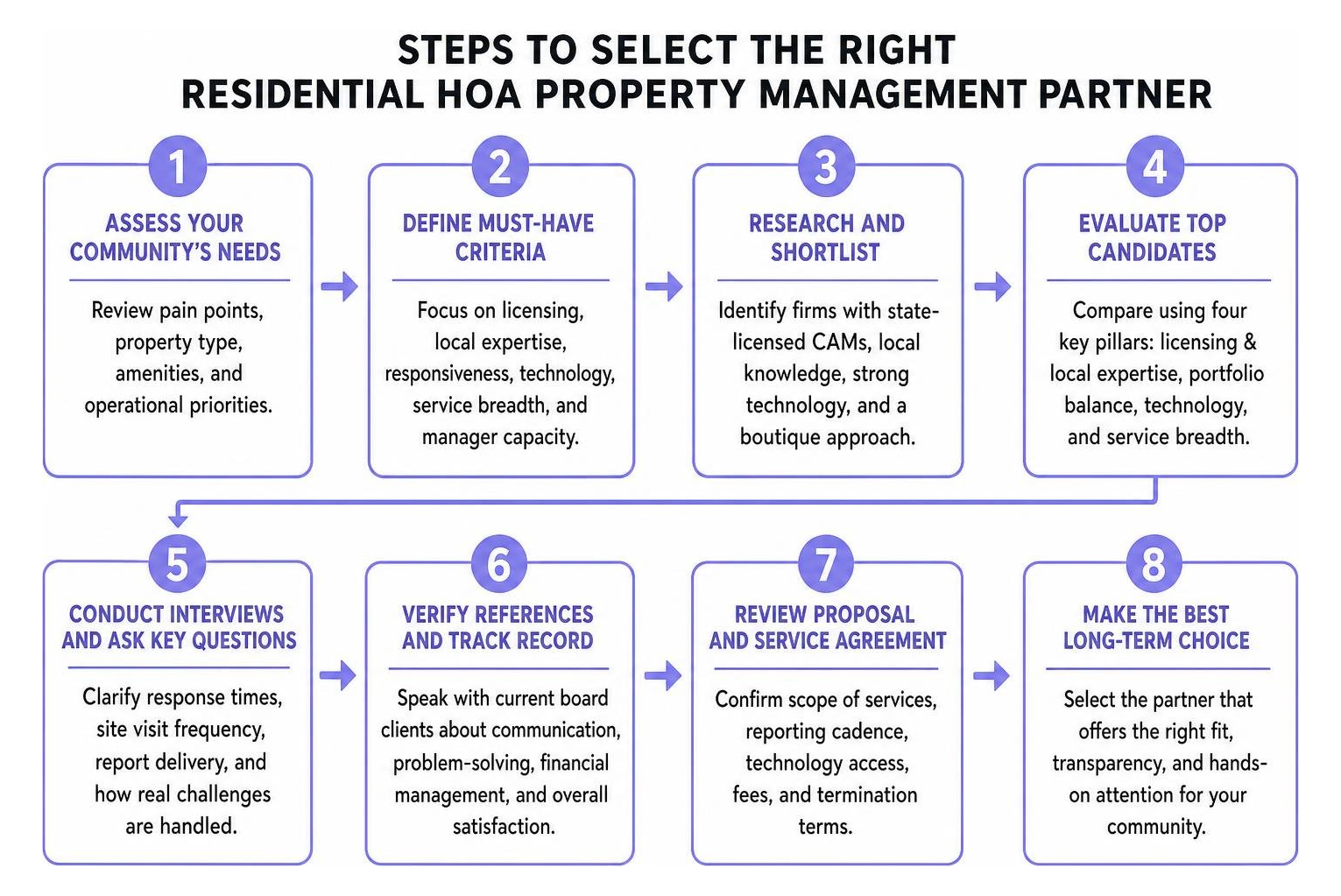
When vetting prospective partners across Miami, Fort Lauderdale, Aventura, Sunny Isles Beach, Dania Beach, Hollywood, and North Miami Beach, boards should evaluate candidates using four primary pillars:
- Licensing and Local Expertise: Confirm that the firm employs state-licensed Community Association Managers (CAMs) who understand municipal codes, regional weather challenges, and local vendor markets.
- Portfolio Balance and Manager-to-Property Ratios: Large national management corporations often overload their managers with 15 to 20 properties, resulting in slow communication and missed details. Look for a boutique approach where managers maintain focused portfolios and provide hands-on attention.
- Integrated Technology Infrastructure: Modern communities require seamless tools. Ensure the firm provides user-friendly portals for real-time architectural review submissions, work-order tracking, online dues payments, and immediate financial visibility.
- Comprehensive Service Breadth: Beyond basic bookkeeping, check whether the company offers robust residential property services, including capital project oversight, violation resolution, and routine site inspections.
Key Questions to Ask Homeowner Association Property Management Companies During Interviews
During the interview phase, prepare targeted questions that reveal how candidate firms handle real-world challenges:
- Operational Response: What is your guaranteed response time for routine homeowner inquiries versus after-hours emergency calls?
- Site Presence: How frequently will our assigned manager walk our property, and how are inspection reports delivered to the board?
- Financial Controls: What internal controls and separation of duties do you have in place to safeguard our association’s operating and reserve accounts?
- Vendor Relationships: Do you accept referral fees or kickbacks from maintenance vendors, or do all negotiated trade discounts pass directly to the association?
- Contract Transparency: Which services are included in the base management fee, and which trigger supplemental administrative charges?
Transitioning and Reviewing Management Performance
Transitioning management companies can feel daunting to a volunteer board, but with an organized plan, it is a straightforward process. A standard onboarding timeline takes between 30 and 60 days, during which your incoming team does the heavy lifting.

Managing the 30-to-60 Day Onboarding Process
A professional transition ensures daily community operations continue without interruption while your records, finances, and vendor agreements are migrated. Discover how structured residential property management creates stability throughout each onboarding phase:
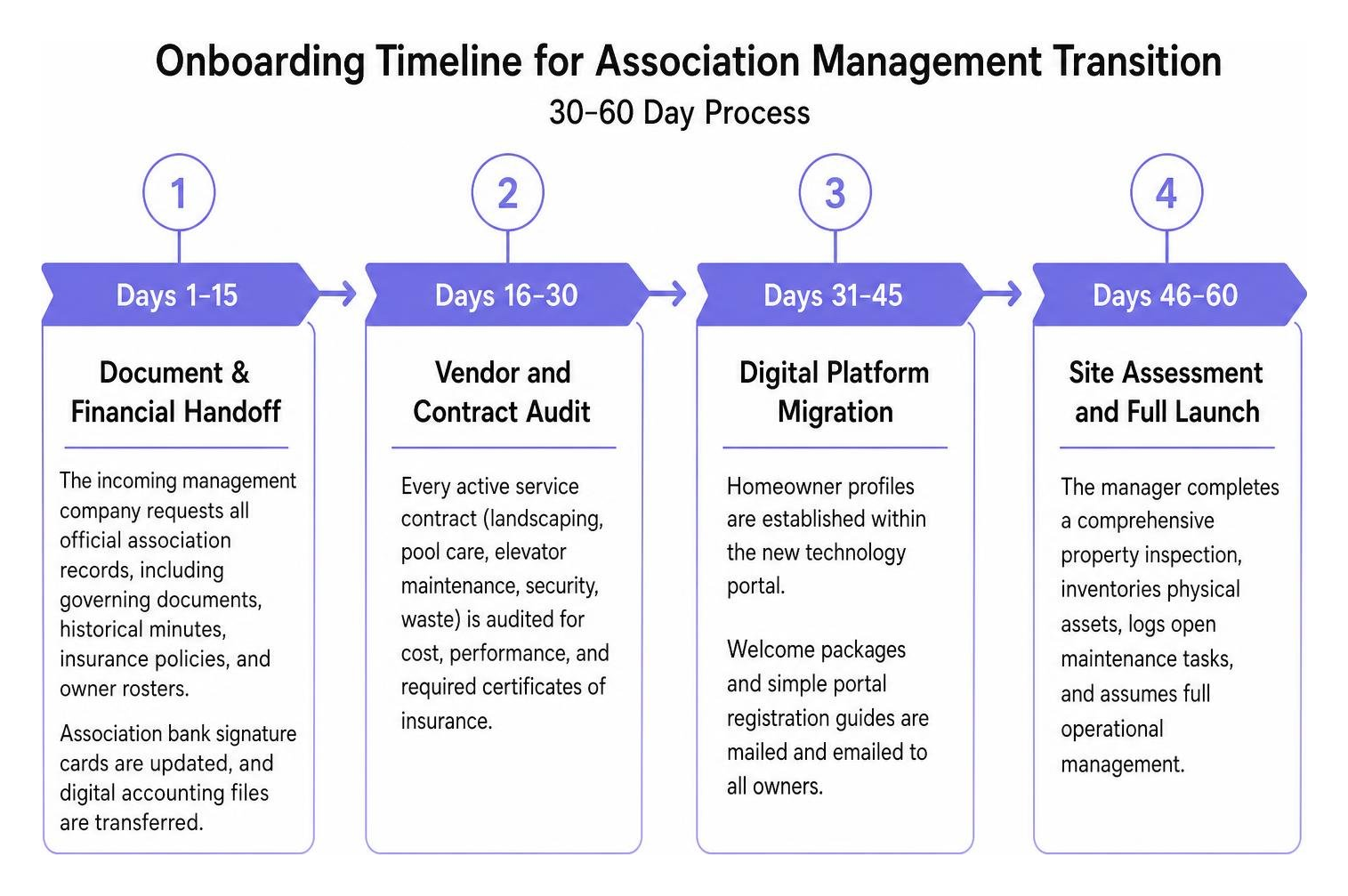
- Phase 1: Document & Financial Handoff (Days 1–15): The incoming management company requests all official association records from the outgoing agent, including governing documents, historical minutes, insurance policies, and owner rosters. Association bank signature cards are updated, and digital accounting files are transferred.
- Phase 2: Vendor and Contract Audit (Days 16–30): Every active service contract (landscaping, pool care, elevator maintenance, security, waste) is audited for cost, performance, and required certificates of insurance.
- Phase 3: Digital Platform Migration (Days 31–45): Homeowner profiles are established within the new technology portal. Welcome packages and simple portal registration guides are mailed and emailed to all owners.
- Phase 4: Site Assessment and Full Launch (Days 46–60): The manager completes a comprehensive property inspection, inventories physical assets, logs open maintenance tasks, and assumes full operational management.
Auditing Performance and Contract Terms to Avoid Hidden Fees
To build a productive long-term relationship, the board should establish clear Key Performance Indicators (KPIs) during the initial 90 days. Schedule quarterly reviews to assess management performance across core areas:
- Financial Promptness: Are monthly financial statements delivered by your agreed-upon target date each month?
- Work-Order Velocity: Are routine resident maintenance tickets acknowledged within 24 hours and resolved within established targets?
- Violation and AR Consistency: Are compliance letters and assessment reminders sent predictably according to statutory schedules?
- Contract Clarity: Review management billing carefully to ensure no unexpected fees appear for standard administrative tasks like digital file storage or regular board meeting attendance. Ensure your agreement contains fair 30- to 60-day termination clauses without onerous cancellation penalties.
Frequently Asked Questions About HOA Management
Are HOA management companies worth the cost for small communities?
Yes. Smaller associations often face the same legal, financial, and structural requirements as large developments, but spread across fewer owners. While small communities may not require an on-site manager, a portfolio management arrangement provides professional financial reporting, vendor oversight, and regulatory guidance. Furthermore, management companies often help small properties save money by securing preferred vendor rates on services like landscaping, pest control, and insurance that individual communities cannot negotiate on their own.
What percentage of HOAs use professional management services?
Approximately 75% of residential community associations across the United States operate under professional management. As residential compliance rules, property insurance markets, and building safety regulations become more complex, volunteer boards increasingly turn to licensed managers to fulfill their fiduciary duties and protect community property values.
How do boards know if their current management company is performing well?
A high-performing management company makes board meetings shorter, financials clearer, and community interactions smoother. Indicators of a successful partnership include:
- Financial statements delivered consistently on time each month without accounting discrepancies.
- Fast, professional responses to board and resident inquiries.
- Proactive site inspections that catch maintenance needs before they turn into costly capital emergencies.
- Transparent reporting on vendor bids, projects, and rule enforcement.
Making the Right Choice for Your Community
Guiding a residential community association requires striking a balance between financial stewardship, legal compliance, and community care. When board members are left to juggle routine maintenance, vendor follow-ups, and accounting on their own, burnout is common—and community assets can suffer.
At Management 305, we deliver proactive, boutique-style community association management throughout South Florida, including Miami, Fort Lauderdale, Aventura, Sunny Isles Beach, Dania Beach, Hollywood, and North Miami Beach. By combining integrated real-time portals with hands-on property oversight, we help boards run their communities smoothly and efficiently.
If your board is ready to streamline daily operations, protect your community's long-term property values, and give volunteer directors their time back, reach out to our team at Management 305 today. Let's discuss a customized management plan tailored to your community. To learn more about our dedicated association services, explore our CAM solutions or visit our main page to see how we help residential communities thrive.
