
What Is Community Association Mgmt and How Does It Work?

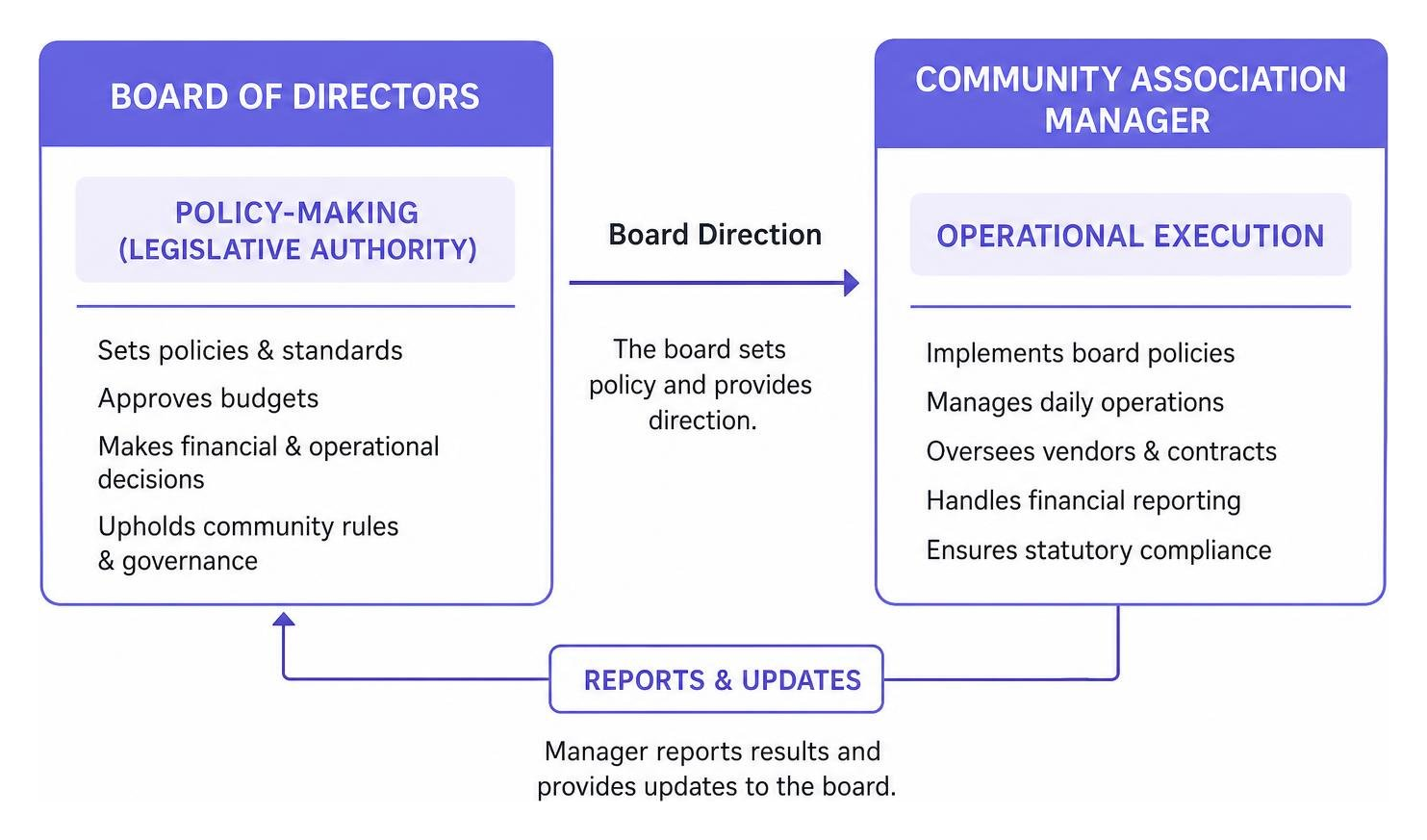
Community association mgmt is the professional administration of a deed-restricted community on behalf of its elected board of directors. A community association manager executes board policies, coordinates daily maintenance, oversees service providers, manages association finances, and ensures statutory compliance across common areas and shared assets.
At its core, a community association operates as a specialized non-profit corporation governed by a shared-governance model. When homeowners purchase a property in a deed-restricted community, they automatically become members of this corporation. The primary purpose of this structure is to maintain common property, protect shared real estate assets, and uphold uniform community standards that sustain property values over time.
Because community associations are democratic entities, property owners elect a volunteer Board of Directors from among their peers. This board holds the fiduciary responsibility to make operational, financial, and policy decisions on behalf of the entire membership. However, managing the continuous demands of a residential complex—from vendor contracts to financial reporting—can quickly overwhelm volunteer directors who balance full-time careers and personal lives.
This operational gap is where professional community association management comes in. Management acts as the operational arm of the elected board. While the board retains sole legislative and policy-making authority, the manager executes those directives, coordinates daily maintenance, oversees service providers, and ensures statutory compliance across all operations.
Understanding the Difference Between CAM and Property Management
It is common to confuse community association management with traditional rental property management, but their fundamental legal structures and operational objectives differ substantially.
- Property Management (Landlord-Tenant Focus): Traditional property managers represent individual property owners or real estate investors. Their primary duties center around leasing individual units, screening prospective tenants, collecting monthly rent, managing unit-level interior repairs, handling lease turnovers, and maximizing return on investment for the landlord.
- Community Association Management (Board-Member Focus): Community association managers serve the entire ownership entity represented by an elected board of directors. Rather than managing individual private residences or landlord-tenant disputes, CAMs oversee the shared elements of the property—such as structural envelopes, clubhouses, elevators, pools, landscaping, and private roads. Their focus rests on fiduciary execution, administrative governance, budget management, assessment collections, covenant enforcement, and maintaining the long-term value of shared assets.
To balance individual unit needs alongside master community requirements, boards often rely on comprehensive management services that bridge operational oversight with structural preservation.
Main Types of Managed Communities
Community association management adapts across several property frameworks, each with unique governance models and statutory requirements:
- Homeowners Associations (HOAs): In an HOA, residents own their individual home and the parcel of land it sits on. The association owns and maintains the common grounds, private roads, clubhouses, and recreational facilities.
- Condominium Associations (COAs): In a condominium, owners hold title to the interior air space of their individual units, alongside an undivided shared interest in the building's common elements (roofs, exterior walls, structural foundations, hallways, and elevators). Because structural and mechanical components are shared, condominium management requires rigorous financial planning for structural reserves and preventative maintenance.
- Housing Cooperatives (Co-ops): In a co-op, residents do not own real property. Instead, they purchase shares in a corporation that owns the entire building and land. Owning shares entitles the member to a proprietary lease on a specific unit. Co-op boards generally exercise strict vetting procedures regarding incoming shareholders and corporate transfers.
- Community Development Districts (CDDs): Common across high-growth regions, a CDD is a local, special-purpose government framework authorized to finance, construct, operate, and maintain major community-wide infrastructure (water management systems, major thoroughfares, utilities, and conservation areas). CDD assessments are typically collected alongside municipal property taxes and carry distinct statutory oversight.
Local municipal frameworks, such as municipal guidelines for associations, outline the regulatory intersections between city ordinances, civil statutes, and local community leadership.
Core Responsibilities of Professional Community Association Managers
A professional manager provides operational continuity for an association. When board memberships turn over during annual elections, the management company preserves institutional knowledge, maintains operational records, and executes daily tasks without disruption.
Financial Administration and Reserve Planning
Accurate financial stewardship protects property values and maintains community solvency. Community managers prepare detailed annual operating budgets, establish automated assessment collection protocols, reconcile bank accounts, and prepare comprehensive monthly financial packages for board review.
Beyond operating expenses, managers assist boards with long-term reserve fund planning. By coordinating professional reserve studies, managers help associations accurately project the remaining useful life of major physical components (roofs, pavement, exterior painting, elevators, mechanical systems) and establish funding schedules to avoid unexpected special assessments.
| Financial Management Task | Self-Managed Associations | Professionally Managed Associations |
|---|---|---|
| Assessment Billing & Collections | Manual check processing; ad-hoc logging prone to human error and accounting delays. | Automated digital portals with electronic ACH, debit, and credit payment processing. |
| Delinquency Management | Direct board contact with neighbors, often creating awkward personal friction. | Systematic collection policies with automated late notices and seamless legal escalations. |
| Monthly Financial Reporting | Basic spreadsheets often delayed by volunteer schedule constraints. | Standardized GAAP-compliant balance sheets, income statements, and budget-vs-actual reports. |
| Invoice Processing & AP | Paper checks routed through physical board signatures, risking late fees. | Cloud-based invoice approval workflows with verified vendor insurance documentation. |
| Reserve Fund Allocation | Often underfunded due to short-term cost pressures or lack of technical insight. | Data-driven funding models backed by specialized reserve studies and statutory requirements. |
Governance, Compliance, and Rules Enforcement
Association governance requires adherence to local real estate statutes, state legislation, and recorded community governing documents (Declaration of Covenants, Conditions, and Restrictions, Bylaws, and Articles of Incorporation). Managers assist boards by drafting meeting agendas, ensuring proper statutory meeting notices, managing proxy distribution, and overseeing annual election protocols.
Equally critical is the impartial enforcement of community standards. When rules are enforced inconsistently, associations face exposure to selective enforcement claims. Managers carry out objective, documented property inspections and administer uniform violation notices pursuant to approved community association policies. When disputes arise regarding architectural modifications or parking rules, the manager acts as a neutral administrator, minimizing personal tension between neighbors.
Maintenance Oversight and Resident Communication
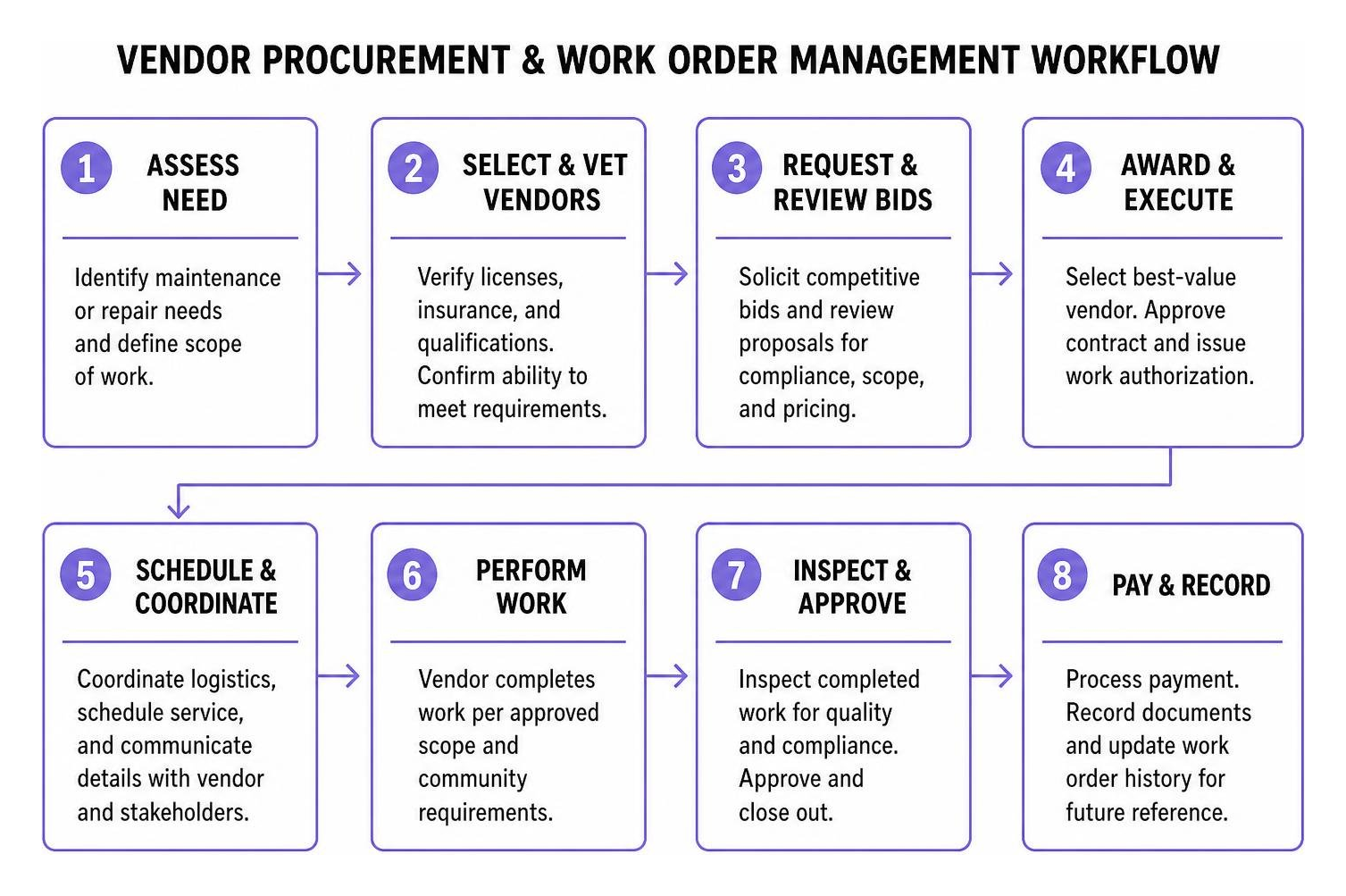
Common-area infrastructure demands steady, preventative care. Managers develop comprehensive maintenance schedules, conduct regular physical walk-throughs, identify necessary repairs, create clear scopes of work, and solicit competitive bids from licensed, insured service contractors.
Modern management combines physical property oversight with clear communication channels. Utilizing real-time resident portals, managers provide owners with 24/7 access to account balances, digital architectural review submissions, association records, and community announcements.
Self-Managed vs. Professionally Managed Associations
Associations face a fundamental operational choice: manage all operations in-house using volunteer directors, or partner with a professional management company.
Weighing Costs, Legal Compliance, and Board Workload in Community Association Mgmt
Self-management is often chosen to avoid monthly management fees. For small associations with minimal common elements, self-management can be functional if board members have professional backgrounds in accounting, property maintenance, and legal compliance.
However, as associations grow in size or complexity, the administrative demands escalate rapidly. Volunteer board members often experience severe burnout after spending dozens of hours each month coordinating vendors, reconciling bank accounts, tracking delinquent payments, and mediating neighbor disputes.
From a liability perspective, self-managed boards assume direct exposure if statutory deadlines are missed, elections are improperly noticed, or reserve funds are mismanaged. Professional management mitigates these risks by establishing standardized operating procedures, maintaining strict compliance calendars, and ensuring institutional continuity across board transitions.
Industry Credentials, Licensing, and Growth in 2026
The community association sector is one of the fastest-growing segments in residential real estate. According to data from the Community Associations Institute (CAI), roughly 3,000 to 4,000 new community associations form annually across the United States, with 66% of newly completed single-family homes situated in association-governed neighborhoods.
State Licensing Requirements and CAI Designations in Community Association Mgmt
To ensure consumer protection and ethical governance, several states require community association managers to hold formal state licenses. Florida maintains rigorous regulatory oversight through the Department of Business and Professional Regulation (DBPR), mandating a state CAM license for any individual who manages associations with more than 10 residential units or an annual operating budget exceeding $100,000.
Beyond state-level licenses, national professional credentials issued by the Community Associations Institute establish clear benchmarks for operational expertise:
- Certified Manager of Community Associations (CMCA): Administered by the Community Association Managers International Certification Board (CAMICB), this foundational accreditation validates core knowledge in financial management, governance, ethics, risk management, and property maintenance.
- Association Management Specialist (AMS): Awarded to managers who have earned the CMCA credential, completed advanced specialized coursework, and accumulated at least two years of verifiable management experience.
- Professional Community Association Manager (PCAM): The highest professional designation in the industry, requiring more than five years of direct management experience, comprehensive coursework, and the completion of an extensive community case study.
More than 90% of association board members prefer to hire credentialed management professionals to safeguard their communities' operational and financial well-being.
Growth Trends and Technological Shifts
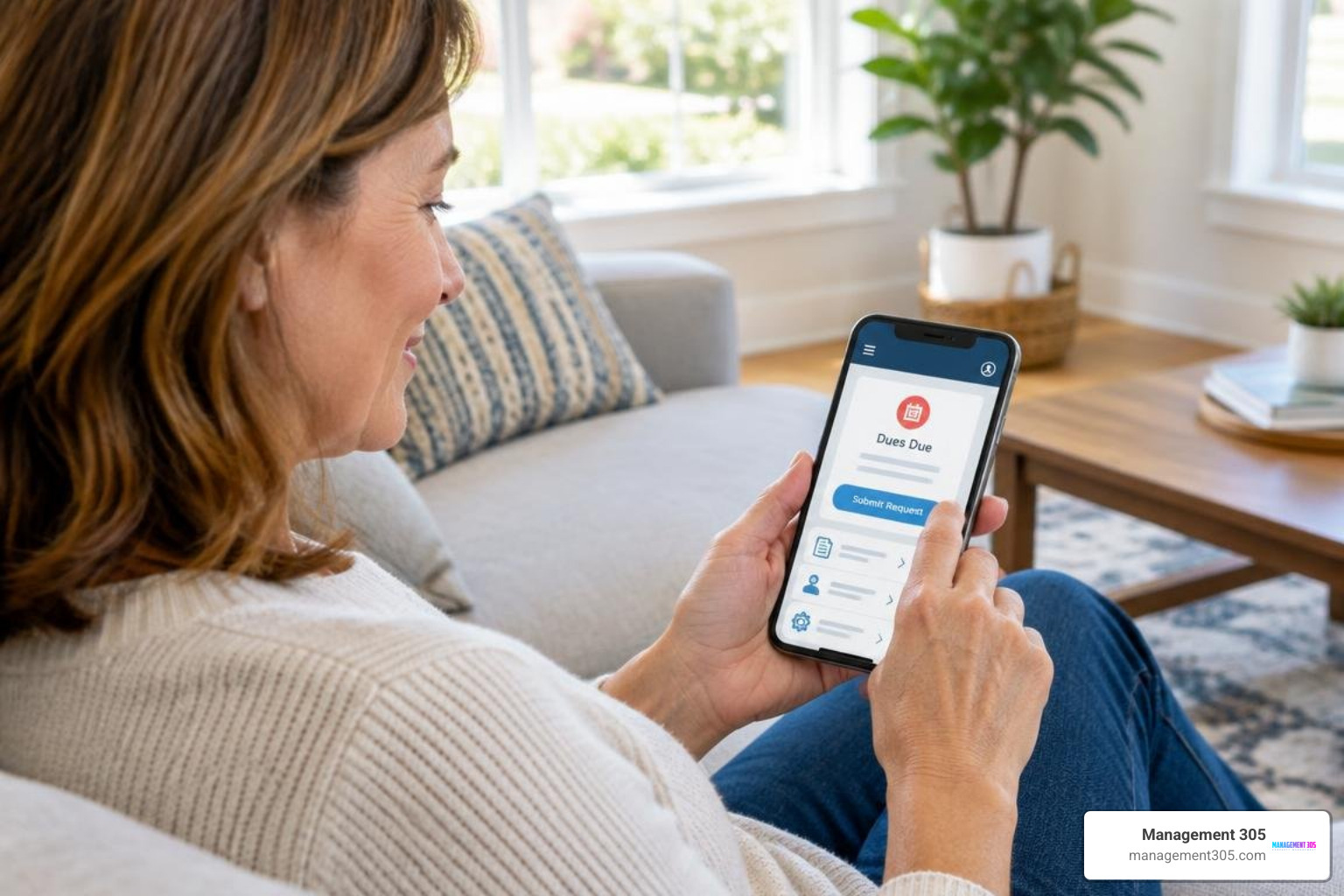
The management sector has shifted toward digital-first, automated administration. Industry surveys from 2025 and 2026 indicate that electronic payments (adopted by 76% of CAM firms) and specialized cloud accounting platforms (utilized by 74% of firms) are foundational industry standards. Modern communities now utilize integrated platforms featuring:
- Automated Architectural Requests: Homeowners submit plans, paint swatches, and permits online, with automated routing to committee members for digital review.
- Virtual Board Meetings and Digital Voting: Secure platforms streamline annual election voting, meeting statutory quorum requirements without complex paper ballots.
- Real-Time Work Order Tracking: Board members and owners monitor vendor progress, invoice approvals, and repair milestones directly through dedicated portals.
Five Key Indicators of a Well-Managed Community Association
Whether you serve on an elected board or are evaluating a new home purchase, five objective benchmarks highlight a healthy, well-administered community:

- Fully Funded, Transparent Reserves: The association maintains up-to-date reserve studies, diligently funds capital accounts, and avoids frequent special assessments for routine major replacements.
- Proactive Maintenance and Clean Common Areas: Infrastructure, landscaping, roofing, and mechanical equipment receive routine servicing before small defects develop into expensive emergency repairs.
- Equitable, Consistent Rule Enforcement: Policies, architectural standards, and parking rules are administered impartially without personal bias or selective enforcement.
- Open, Multi-Channel Communication: Financial reports, meeting minutes, budgets, and project updates are readily accessible through real-time online portals and timely notices.
- Active, Collaborative Board Governance: Board meetings are conducted efficiently using structured parliamentary procedures, focusing on strategic policy decisions while delegating operational tasks to professional management.
Frequently Asked Questions About Community Association Management
What is the primary role of a community association manager?
The primary role of a community association manager is to execute the policies and decisions set by the board of directors. The manager oversees daily community operations, collects dues, coordinates maintenance providers, prepares draft budgets, and acts as an administrative resource for owners and board members.
Are all community association managers legally required to be licensed?
Licensing requirements vary by jurisdiction. States such as Florida legally require individuals managing associations with over 10 units or budgets exceeding $100,000 to hold a state-issued Community Association Manager (CAM) license. In states without mandatory licensing, top professionals demonstrate expertise by earning national credentials such as the CMCA, AMS, or PCAM designations through the Community Associations Institute.
How does hiring a professional management company reduce board liability?
Professional management companies protect boards by ensuring strict adherence to statutory notice requirements, corporate bylaws, and open-meeting laws. Managers provide objective documentation for rules enforcement, maintain verified vendor insurance records (including workers' compensation and general liability), and coordinate CPA audits to ensure sound financial administration.
Conclusion
A successful community association balances sound financial planning, consistent property upkeep, and open communication. When volunteer board members shoulder every operational detail alone, burnout and administrative delays often follow. Partnering with a professional team brings structure and consistency to shared living.
At Management 305, we deliver technology-enabled, boutique community association management solutions built for South Florida communities. By pairing real-time digital owner portals with responsive on-site leadership across Miami, Aventura, Sunny Isles Beach, Hollywood, Dania Beach, North Miami Beach, and Fort Lauderdale, we help boards protect property values, streamline compliance, and build better neighborhoods.
