
What a Criminal Background Check Means for Renters

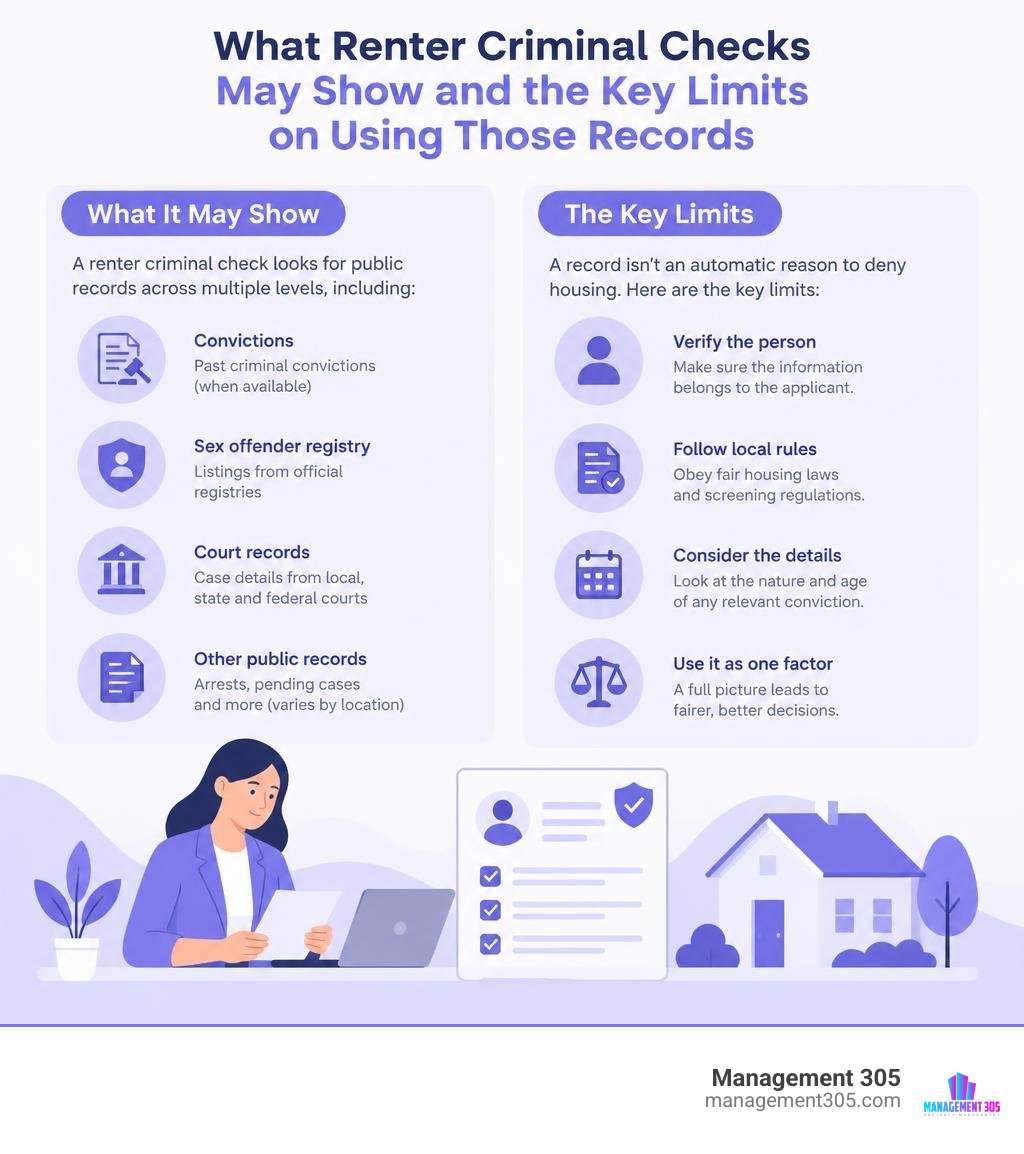
A criminal background check for renters searches available records for information such as convictions and sex offender registry listings. Landlords may use it to assess a rental application, but a record is not an automatic reason to deny someone housing. They should check that the information belongs to the applicant, follow local screening rules, and consider the nature and age of any relevant conviction.
I’m Cédric Rose, founder of Management 305, with more than 14 years of experience overseeing residential properties and leasing operations in South Florida. That experience shapes how I approach a criminal background check for renters: as one part of a fair, well-documented leasing decision.
What Is Included in a Criminal Background Check for Renters?
When landlords or residential property managers run a background check, the resulting report aggregates public data across several jurisdictional levels. A standard, comprehensive screening generally looks at:
- National criminal databases: Aggregated indexes searching millions of records across jurisdictions.
- County court public records: Direct filings from local courthouses that capture felony and misdemeanor trial outcomes.
- Statewide repositories: Law enforcement registries tracking adjudicated cases across individual state borders.
- National sex offender registries: Public safety databases covering all 50 states and U.S. territories.
- Federal watchlists: Office of Foreign Assets Control (OFAC) sanctions and terrorist screening databases.
Conducting a thorough background check for rental applicants helps housing providers protect community safety while ensuring the applicant's identity is correctly verified.
Scope of Records: Convictions vs. Arrest Records
Understanding the distinction between an arrest record and an actual conviction is critical in residential screening. An arrest reflects an unproven accusation, whereas a conviction represents a formal finding of guilt by a court of law.
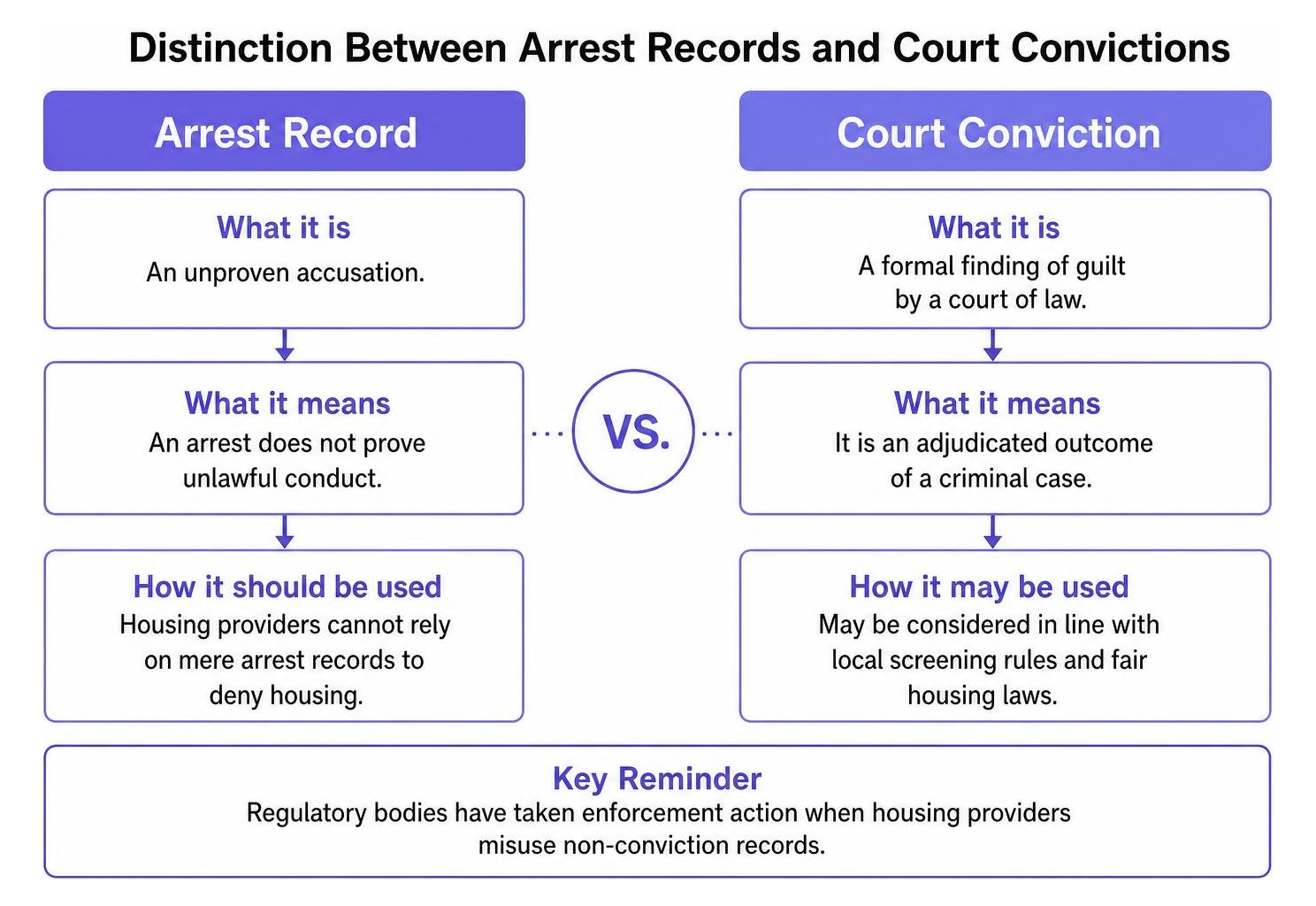
Housing providers cannot rely on mere arrest records to deny housing. Federal and state guidance emphasizes that an arrest does not prove unlawful conduct. Regulatory bodies have taken active enforcement actions when housing providers misuse non-conviction records. For example, recent Colorado AG enforcement actions on rental application compliance highlighted that penalizing applicants for unresolved or dismissed criminal charges violates fair screening mandates.
Excluded and Protected Records
Not every public record can legally influence a rental decision. In residential leasing, housing providers must exclude:
- Sealed or expunged criminal records
- Juvenile court adjudications
- Dismissed charges or completed pre-trial diversion programs
- Outdated civil proceedings exceeding standard statutory reporting windows
Legal Framework and Fair Housing Protections in Tenant Screening
Tenant screening operates under federal, state, and local civil rights laws. The U.S. Department of Housing and Urban Development (HUD) enforces guidelines under the Fair Housing Act, which prohibits housing discrimination based on race, color, national origin, religion, sex, familial status, or disability.
Under HUD guidance, screening practices can violate the law under three liability theories:
- Discriminatory Intent: Intentionally applying screening criteria differently based on a protected characteristic (e.g., screening minority applicants more strictly).
- Discriminatory Effect (Disparate Impact): Applying a neutral policy across all applicants that disproportionately excludes protected classes without a necessary business justification.
- Failure to Provide Reasonable Accommodations: Refusing to adjust screening procedures for an applicant with a disability when the past conduct was directly related to that disability and has been mitigated.
Disparate Impact and Federal Anti-Discrimination Rules
National statistics demonstrate systemic disparities within the criminal justice system:
- Black individuals represent roughly 13 percent of the U.S. population but account for roughly 27 percent of all arrests.
- Black males face an incarceration rate 5.7 times that of White non-Hispanic males, while Black females are incarcerated at 1.7 times the rate of White non-Hispanic females.
- Hispanic individuals are incarcerated in state facilities at 1.3 times the rate of White non-Hispanic individuals.
- Housing research indicates that when landlords apply purely discretionary screening policies, they favor White applicants over similarly situated Black applicants 55 percent of the time.
Because blanket exclusions disproportionately harm protected groups, automatic disqualifications for any criminal history violate federal standards. Official Fair Housing and Criminal History guidance clarifies that housing providers must demonstrate that any exclusion is directly related to safety and property protection.
Conducting an Individualized Assessment for Criminal Background Check for Renters
Rather than rejecting applicants automatically, landlords must conduct a tailored, case-by-case evaluation. Our guide on running a criminal background check for landlords details how to structure these evaluations around four core criteria:
- Offense Severity: Distinguishing between minor infractions, nonviolent misdemeanors, and serious violent crimes.
- Time Elapsed: Evaluating how much time has passed since the conviction or completion of the sentence.
- Age at Incident: Considering whether the offense occurred during young adulthood or years in the past.
- Direct Relevance: Determining whether the specific past conduct poses an ongoing threat to residents or rental property integrity.
Evaluating Mitigating Factors and Rehabilitation Evidence
When an individualized assessment is conducted, applicants should have the opportunity to provide contextual evidence, such as:
- Proof of completed rehabilitation programs, vocational training, or educational degrees
- Steady employment history and consistent income verification
- Positive references from prior landlords, community leaders, or case managers
- Documentation showing domestic violence survivor protections under the Violence Against Women Act (VAWA)
- Evidence of medical treatments or behavioral therapies supporting a reasonable accommodation request
Costs, Turnaround Times, and Jurisdictional Fee Regulations

A thorough screening protects housing providers from substantial financial liabilities. For example, industry surveys indicate the average cost of an eviction reaches $3,500 when factoring in legal filings, court appearances, and turnover delays.
State and Local Limits on Screening Fees
State laws regulate the amount a landlord can charge prospective tenants for screening:
| Jurisdiction | Maximum Allowable Screening Fee | Key Procedural Requirement |
|---|---|---|
| California | Capped at $64 | Landlord must provide an itemized receipt |
| New York | Capped at $20 | Fee waived if tenant supplies a recent report |
| Wisconsin | Capped at $25 | Fee waived if tenant provides recent credit history |
| Massachusetts | $0 (No application fee permitted) | Landlords must cover all screening costs |
Additionally, certain jurisdictions require a "conditional acceptance" step—mandating that a landlord make a provisional rental offer based on financial qualifications before running any criminal background check.
Typical Processing Times and Reporting Delays
Most automated digital screenings return nationwide database searches in minutes. However, routine delays can extend processing times to 24 to 72 hours under specific conditions:
- Manual Court Searches: Certain county courthouses require physical or clerk-assisted file retrieval.
- Identity Verification: Additional validation is required when applicants share common names.
- False-Positive Resolutions: Verifying identifiers to ensure an unrelated individual's record does not attach to the applicant.
How Landlords and Applicants Navigate a Criminal Background Check for Renters
Navigating screening requirements demands transparency from landlords and proactive diligence from renters. Partnering with a professional team for property management ensures screening workflows remain compliant with evolving housing regulations.
Steps for Landlords: Compliant Screening Policies and Adverse Action
Housing providers must implement uniform procedures under the Fair Credit Reporting Act (FCRA):
- Establish Written Criteria: Distribute transparent screening guidelines to all applicants before collecting fees.
- Issue Pre-Adverse Action Notices: If a record might lead to denial, provide the applicant with a copy of the screening report and a summary of their consumer rights.
- Allow Review Time: Give the applicant a reasonable window to dispute errors or submit mitigating evidence.
- Deliver Final Adverse Action: If the denial stands, issue a formal written adverse action letter detailing the screening agency used and notifying the applicant of their 60-day window to obtain a free report. Guidance from the FTC on tenant background checks outlines these consumer notification requirements.
Steps for Renters: Disputing Inaccuracies and Asserting Rights
Renters who discover inaccurate or outdated records on their report should take the following steps:
- Initiate an Official Dispute: Contact the consumer reporting agency in writing to dispute errors; agencies must investigate and resolve disputes within 30 days.
- Provide Certified Documentation: Submit certified court dismissal orders, certificates of expungement, or proof of identity to correct reporting mismatches.
- File Agency Complaints: If a housing provider applies blanket exclusions or refuses individualized assessments, renters may file a complaint with HUD's Office of Fair Housing and Equal Opportunity.
Frequently Asked Questions About Criminal Screening for Tenants
Can a landlord automatically reject an applicant with a felony conviction?
No. Blanket policies that categorically reject anyone with a felony conviction violate HUD fair housing guidelines due to their disparate impact. Landlords must evaluate the severity, recency, and property-related risk of the specific offense through an individualized assessment.
How long does a criminal background check remain visible on a rental report?
Under the federal FCRA, civil judgments and non-conviction arrest records generally drop off consumer reports after seven years. Convictions may appear indefinitely under federal law, though many state laws restrict reporting periods to seven years or limit consideration to recent offenses.
Who is responsible for paying the rental screening fee?
Responsibility depends on local regulations. In many markets, applicants pay a processing fee directly through an online application portal. In jurisdictions like Massachusetts, landlords must cover all screening costs.
Conclusion
Conducting compliant, balanced criminal background checks protects residential rental properties while upholding fair housing standards. By avoiding blanket disqualifications, performing individualized assessments, and respecting statutory fee limits, property owners can identify qualified residents while minimizing regulatory risk.
At Management 305, we provide comprehensive, technology-driven leasing and residential management across South Florida communities, including Miami, Fort Lauderdale, Aventura, Sunny Isles Beach, Hollywood, Dania Beach, and North Miami Beach. Contact us today to explore our residential leasing and management services tailored to your rental portfolio.
— Cédric Rose, Founder, Management 305
