
A Quick Start Guide to Rental Applicant Background Checks
How to Run a Background Check for Rental Applicants

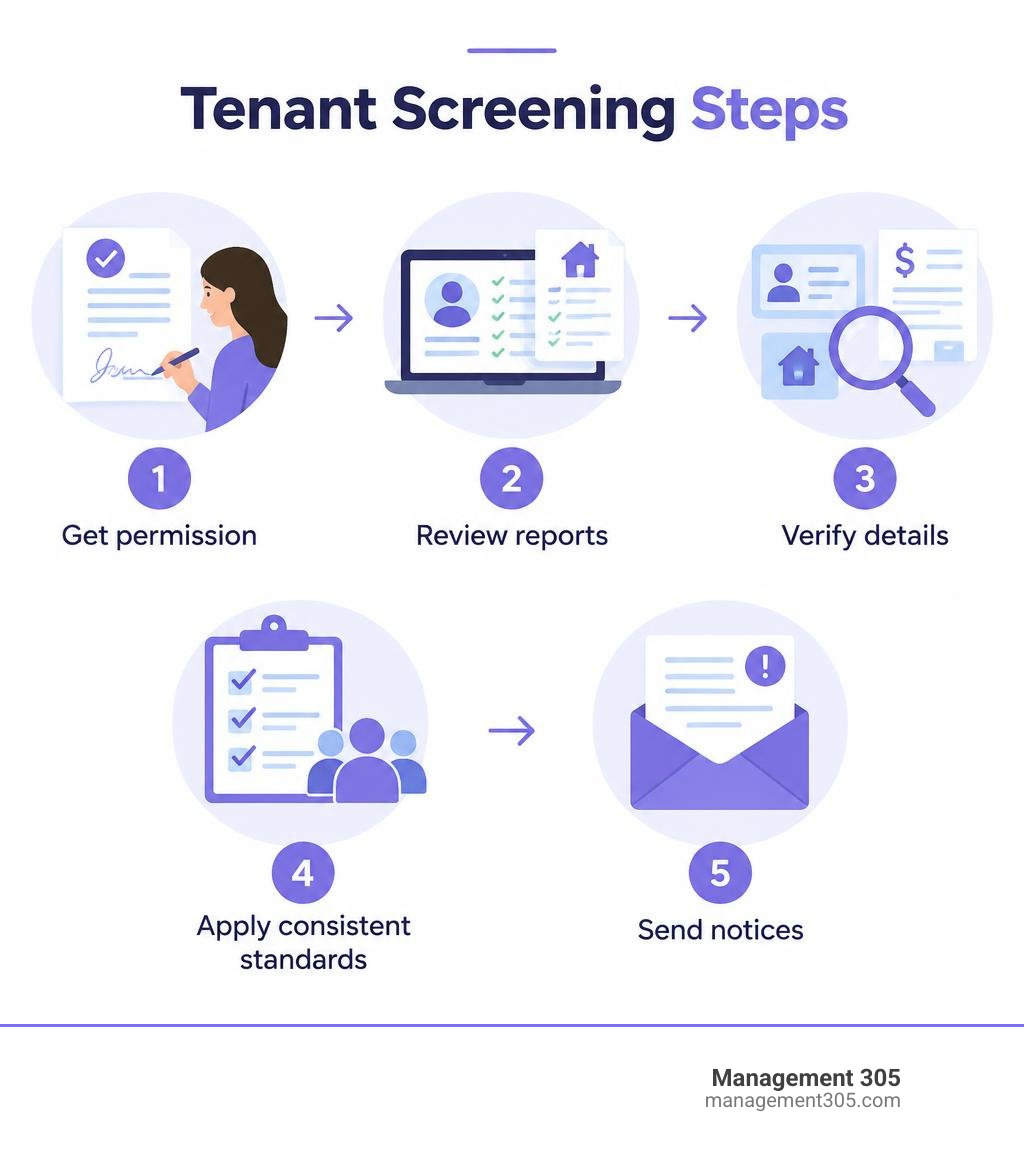
Start with the applicant's written permission. Use a tenant-screening service to review credit, criminal, and eviction records. Then verify income and rental history. Apply the same written standards to every applicant, and provide an adverse action notice if a report leads to a denial or stricter lease terms.
A check can help you spot risks before signing a residential lease. It also gives you a clearer basis for a fair, documented decision.
I'm Liraz Rose, a contributor to Management 305 with a background in HR leadership and residential property management. I bring that people-and-process experience to this guide on using a background check for rental applicants fairly and effectively.
Essential Components of a Background Check for Rental Applicants
Placing a great tenant in your rental property is one of the most rewarding parts of owning residential real estate. Finding that dream renter, however, requires more than a friendly smile and a firm handshake. A complete screening package provides an objective, data-backed look at an applicant's financial reliability, past tenancy history, and overall trustworthiness.

Every rigorous screening review should include several foundational layers:
- Identity Verification & SSN Trace: Confirms that the prospective tenant is indeed who they claim to be, validates their Social Security number, flags known aliases, and tracks prior addresses across different jurisdictions.
- Credit Report & Resident Scoring: Highlights credit payment patterns, outstanding collection accounts, total revolving debt, and bankruptcies.
- Nationwide Criminal Record Search: Scans national databases, state repositories, local county court records, the national sex offender registry, and global security watchlists.
- Eviction History Search: Checks civil court filings, unlawful detainer actions, and monetary judgments across regional and national databases.
- Income & Employment Verification: Confirms direct-source employment and validates monthly gross earnings to calculate the rent-to-income ratio.
To help you understand how consumer reporting agencies package these data points, here is how standard screening bundles typically compare:
| Screening Component | Standard Package | Standard Plus Package | Comprehensive Package | Comprehensive + Bank Insights |
|---|---|---|---|---|
| Identity Verification & SSN Trace | Yes | Yes | Yes | Yes |
| Sex Offender & OFAC Watchlists | Yes | Yes | Yes | Yes |
| Nationwide Criminal Search | Yes | Yes | Yes | Yes |
| Detailed Credit Report & Score | No | Yes | Yes | Yes |
| Nationwide Eviction Filings | No | No | Yes | Yes |
| Bank Asset & Income Verification | No | No | No | Yes |
Credit History, ResidentScore, and Financial Reliability
Evaluating credit history goes far beyond glancing at a three-digit credit score. For residential landlords, the goal is understanding how an applicant manages recurring financial obligations. A renter might have a modest credit score due to past student loans or medical bills, yet maintain an unblemished record of on-time rental payments.
Specialized metrics like TransUnion's ResidentScore are designed specifically for rental housing. Unlike standard credit scoring models that assess credit card default risk, ResidentScore predicts rental eviction risk 15% better than traditional credit scores by analyzing rental-specific payment patterns.
When evaluating an applicant's financial background, look for:
- Prior bankruptcies, active charge-offs, or utility collections.
- High debt-to-income ratios that might compromise their ability to pay rent during emergencies.
- A consistent history of making on-time monthly payments across accounts.
Criminal Background and Nationwide Eviction Records
Reviewing public records is essential for keeping residential communities safe and protecting your rental property. Criminal background checks should draw from broad sources, including county court databases, statewide repositories, the national sex offender registry, and Office of Foreign Assets Control (OFAC) global watchlists.
Equally vital is a nationwide eviction search. With over 35 million background checks run across the country every year, cross-referencing multi-state records ensures that past eviction filings from other regions do not slip through the cracks. Considering that the average eviction costs a property owner upwards of $3,500 in lost rent, filing fees, legal representation, and property turnover, running a comprehensive eviction check is one of the smartest preventative steps you can take.
Legal Compliance: FCRA Regulations and Fair Housing Standards
Conducting background checks is not just about gathering data; it is about gathering data legally and responsibly. The Fair Credit Reporting Act (FCRA) and the federal Fair Housing Act establish strict rules designed to protect consumer privacy and prevent systemic discrimination.
Landlords must follow clear guidelines for Florida Tenant Screening Background Checks and federal consumer regulations:
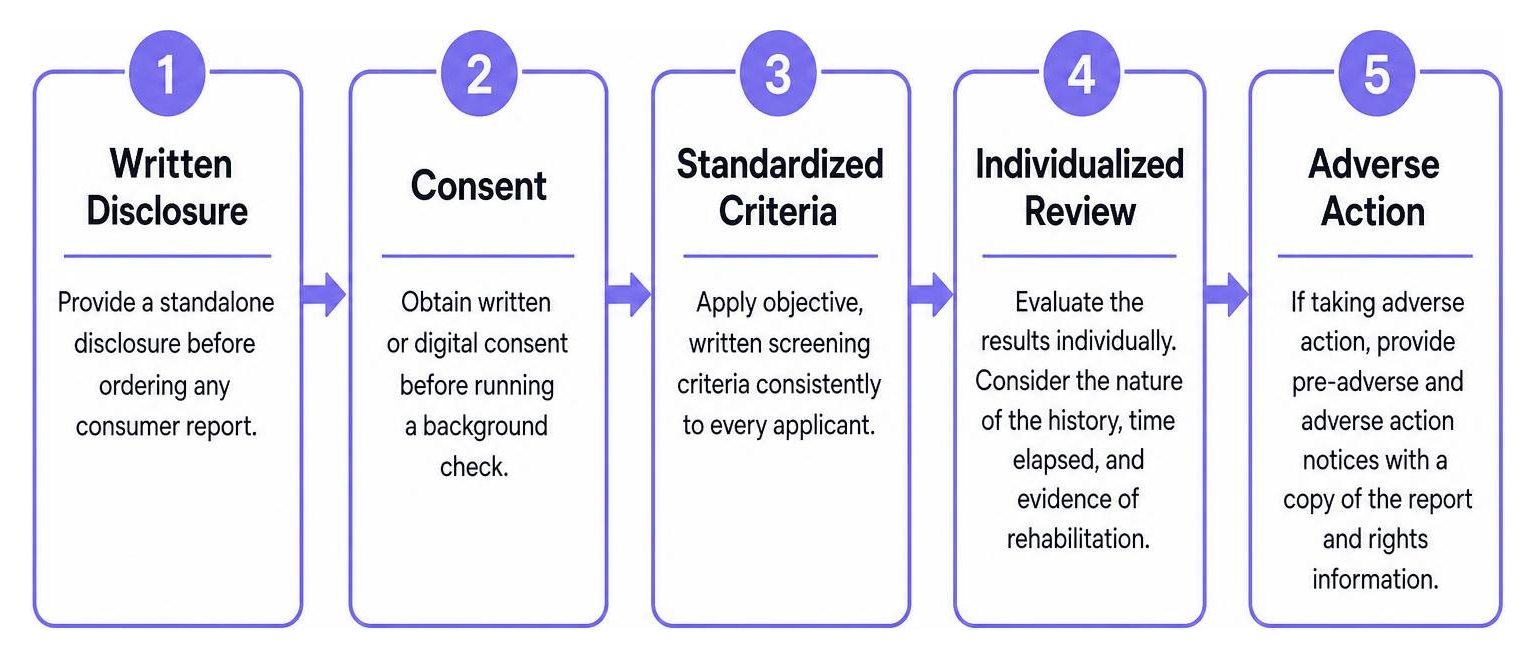
- Obtain Written Consent: You must provide a standalone disclosure and obtain written or digital consent before ordering any consumer report.
- Apply Uniform Selection Criteria: Establish objective, written qualification benchmarks (e.g., minimum credit score, verifiable 3x income-to-rent ratio) and apply them identically to every applicant to avoid Fair Housing violations based on race, color, national origin, religion, sex, familial status, or disability.
- Conduct Individualized Assessments: The U.S. Department of Housing and Urban Development (HUD) advises against blanket bans on applicants with criminal histories. Instead, evaluate the severity of the offense, the time elapsed since the conviction, and evidence of subsequent rehabilitation.
Steps to Run a Background Check for Rental Applicants Legally
Running a legally sound background check for rental applicants requires a structured, repeatable workflow:
- Step 1: Distribute Written Screening Disclosures. Clearly state your rental criteria, application fees, required documentation, and the screening agency you use.
- Step 2: Collect Signed Application & Authorization. Secure applicant consent alongside government-issued photo identification and Social Security numbers.
- Step 3: Run the Screening Reports. Order a comprehensive report through an FCRA-compliant consumer reporting agency.
- Step 4: Verify Supporting Documentation. Cross-reference self-reported employment and income against recent pay stubs, W-2s, or direct-link bank verification.
- Step 5: Apply Objective Scoring Benchmarks. Evaluate the applicant against your predetermined criteria without making arbitrary exceptions.
Adopting professional property management workflows ensures your screening operations stay fully compliant with evolving state and federal housing statutes.
Managing Adverse Action Notices and Applicant Disputes
If you decide to reject an applicant, require a co-signer, or request a higher security deposit based on information contained in a consumer report, the FCRA mandates that you issue a formal Adverse Action Notice.
An Adverse Action Notice must include:
- The specific reason(s) for the unfavorable decision or conditional approval.
- The name, address, and toll-free telephone number of the screening agency that furnished the report.
- A clear statement that the screening agency did not make the rental decision and cannot explain why it was made.
- Notice of the applicant's right to obtain a free copy of their consumer report from the screening bureau within 60 days.
- Notice of their right to dispute the accuracy or completeness of any information directly with the screening agency, which is required by law to investigate errors within a 30-day window.
Turnaround Times, Screening Costs, and Fee Management
Modern screening platforms have streamlined rental onboarding. While traditional manual background checks once took 48 to 72 hours, digital identity verification and real-time database integrations now deliver comprehensive reports in as little as 4 minutes.

Why Every Landlord Needs a Background Check for Rental Applicants
Skipping or rushing tenant screening is one of the riskiest shortcuts a landlord can take. A thorough check:
- Dramatically cuts down the risk of non-payment and mid-lease defaults.
- Protects property condition by screening out applicants with patterns of property damage or lease violations.
- Fosters a safer, quieter environment for neighboring residents in multi-unit properties.
- Saves thousands of dollars by preventing costly court proceedings and turnover delays.
For more strategic leasing insights, explore our practical Advice articles tailored to residential landlords.
Typical Costs and Application Fee Regulations
Application fees are generally structured around the depth of data pulled during screening. In most residential leasing workflows, landlords have two options:
- Applicant-Paid Portals: The landlord sends an online screening invitation, and the applicant pays the screening agency directly when submitting their application.
- Landlord-Paid Collections: The landlord collects an application fee directly from the applicant and pays the screening provider on their behalf.
Regardless of the payment workflow you choose, transparency is essential. Always provide a clear receipt and disclose upfront whether application fees are non-refundable.
Best Practices for Reviewing Rental Reports and Choosing Tenants
To make sound leasing decisions while remaining completely objective, follow these core screening practices:
- Create a Written Rental Criteria Sheet: Document required income ratios, credit thresholds, and acceptable rental references before marketing your home.
- Contact Prior Housing Providers: Speak directly with prior landlords (especially the landlord before their current one, who has no incentive to give an artificially glowing review).
- Authenticate Proof of Income: Check pay stubs for altered figures or use direct bank-linking tools to verify ongoing payroll deposits.
- Maintain Organized Records: Retain rental applications, screening reports, and written correspondence for at least two to three years in secure, encrypted storage.
Frequently Asked Questions About Tenant Screening
How long does a background check take for a rental property?
Most automated screening reports deliver instant results within 4 to 15 minutes. However, turnaround times can extend to 24–72 hours if a local county court requires manual file indexing or if an employer takes extra time to confirm employment.
Who typically pays for the tenant screening background check?
In most rental markets, the applicant pays the screening fee directly via an online application portal. Alternatively, some property owners cover the screening expense as an incentive to attract a broader pool of applicants.
Can a landlord deny an applicant based on an eviction record?
Yes, landlords may generally deny an applicant based on a past formal civil eviction judgment. However, dismissed filings or unresolved eviction cases should be reviewed with an individualized assessment to ensure fair and lawful consideration.
Conclusion
A well-executed tenant screening process is the cornerstone of successful residential property ownership. By combining comprehensive background reports, objective qualification standards, and strict adherence to fair housing laws, you can protect your rental income and secure dependable, long-term residents.
Whether you manage a single-family home or a multi-family community, our team at Management 305 is here to help. Contact us to learn more about our end-to-end residential Services and see how our technology-enabled leasing approach simplifies property oversight across South Florida, including Aventura, Sunny Isles Beach, Hollywood, Dania Beach, North Miami Beach, Miami, and Fort Lauderdale.