
Understanding the Scope of Tenant Criminal Screening

To safely run a criminal background check for landlords, start by obtaining written FCRA-compliant consent from the applicant, then order a combined national criminal database search and direct county-level court search through an accredited Consumer Reporting Agency. Once results return, evaluate any conviction through an individualized assessment that weighs the nature, severity, and recency of the offense rather than applying a blanket denial policy.
Running background checks requires a clear understanding of data depth, search parameters, and verification standards. Modern background screening pulls from tens of thousands of local, state, and federal public records repositories. However, not all databases update at the same frequency, nor do they all contain identical levels of detail.
Screening prospective tenants is not just about checking a single digital box. Real-world property protection relies on multi-jurisdictional database searches paired with direct courthouse records. The goal is simple: confirm that the person applying is who they claim to be, and evaluate whether their past conduct poses a genuine, direct threat to the safety of neighbors, staff, or the physical premises.
Understanding What Appears on a Criminal Background Check for Landlords
A detailed screening report aggregates public records from across the country to give housing providers an unvarnished look at an applicant's adjudicated history. When configured correctly through a reputable Consumer Reporting Agency (CRA), a background check surfaces several distinct categories of data:
- Felony Convictions: Major criminal offenses (such as violent crimes, grand theft, arson, or burglary) that resulted in a formal conviction, plea deal, or sentence.
- Misdemeanor Records: Lesser offenses (such as disorderly conduct, minor property damage, or trespassing) that have reached a final court disposition.
- Active Warrants: Outstanding municipal, county, state, or federal warrants for arrest where a case remains unresolved.
- Disposition and Sentencing Details: Critical context on how a case ended—such as guilty verdicts, acquittals, dismissals, probation terms, deferred adjudications, or completed community service.
- National Sex Offender Registry Data: Comprehensive checks against public sex offender registries across all 50 states, tribal territories, Washington D.C., and the National Sex Offender Public Website (NSOPW).
- Global Security Watchlists: Searches across federal and international enforcement lists, including the Office of Foreign Assets Control (OFAC) sanctions list, FBI Most Wanted, Interpol notices, and terror watchlists.
Crucially, an effective report does not display dismissed charges or unverified allegations without clear final disposition data, ensuring property owners make decisions rooted in verified court records rather than unproven claims.
National Criminal Repositories vs. County-Level Court Searches
One common mistake property owners make is relying entirely on instant "national" database scans. While broad database sweeps search over 900 million records across thousands of jurisdictions, they are secondary aggregator tools. They buy bulk records from jurisdictions on variable update cycles, which means recent filings, changes in case disposition, or sealed dockets may experience latency.
By contrast, direct county courthouse searches query the primary source of truth: the physical or digitized court index in the specific counties where the applicant has lived, worked, or attended school. Direct searches fill the jurisdictional gaps that aggregators miss, verifying whether an open charge was dismissed or if a localized record exists that never made it into a third-party commercial index.
| Search Feature | National Criminal Database | Direct County-Level Court Search |
|---|---|---|
| Primary Purpose | Broad multi-state pointer tool | Deep local verification at source |
| Data Source | Aggregated commercial repositories | Individual county court clerks |
| Update Frequency | Monthly, quarterly, or bi-annually | Real-time / live court docket |
| Disposition Accuracy | Moderate (can lag behind court actions) | High (reflects current case posture) |
| Turnaround Time | Instant to a few minutes | Same-day to 3 business days |
| Best Used For | Catching out-of-area offenses | Verifying local address history |
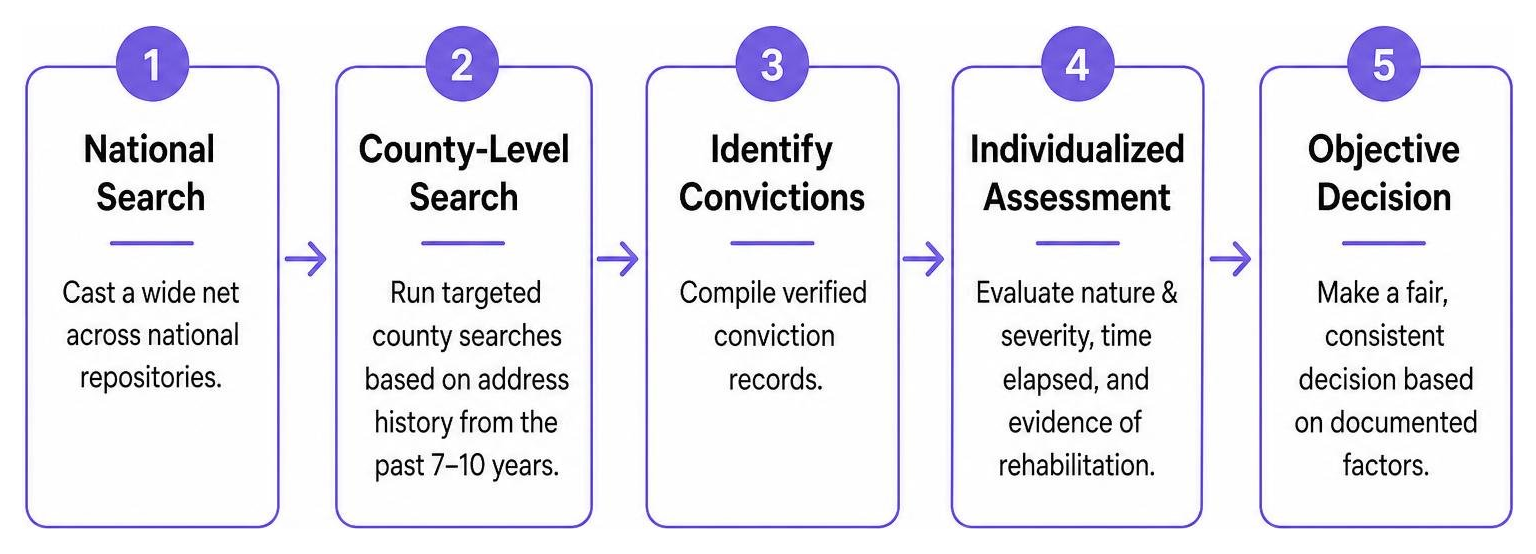
A balanced screening protocol uses national repositories to cast a wide net across jurisdictions and follows up with targeted county-level searches based on the applicant's address history over the past 7 to 10 years.
Legal Requirements for a Criminal Background Check for Landlords
Screening applicants is governed by a strict matrix of federal statutes, administrative guidance, and regional legislation designed to prevent discrimination and protect consumer rights.
Under the Fair Credit Reporting Act (FCRA), background checks used for housing evaluations constitute consumer reports. Housing providers must secure clear, written authorization from the applicant before ordering a report, disclose what information will be obtained, and utilize accredited CRAs that maintain reasonable procedures for maximum possible accuracy.
Beyond credit reporting rules, screening protocols must align with the Fair Housing Act (FHA) and the landmark guidance issued by the U.S. Department of Housing and Urban Development (HUD). HUD's framework makes clear that blanket policies—such as automatically disqualifying anyone with any criminal conviction on their record—often create an unlawful disparate impact against protected classes without advancing genuine property safety. Because minority populations are arrested and convicted at rates disproportionate to their share of the general population, arbitrary exclusions violate federal civil rights standards.
HUD establishes two foundational principles for criminal screening:
- Arrest Records Cannot Form the Basis of Housing Denials: An arrest demonstrates only that an officer suspected someone committed a crime; it does not prove unlawful conduct. Depriving an applicant of housing based on an arrest record without conviction violates fair housing principles.
- Individualized Assessments Are Essential: Landlords should evaluate the nature, severity, and recency of any conviction, weighing how specifically the past conduct relates to tenancy responsibilities.
The legal responsibilities surrounding tenant screening tools were underscored in landmark appellate litigation (Connecticut Fair Housing Center federal appellate ruling). The Second Circuit reaffirmed that while third-party screening platforms report raw public records, housing providers remain responsible for the housing decisions they make. Property owners cannot point to an automated "decline" score from an algorithmic software vendor to shield themselves from fair housing claims; landlords must maintain clear, justifiable criteria for any exclusion.
State laws add another layer of compliance. For instance, reviewing local Florida tenant screening regulations is essential when managing rentals in markets like Miami, Fort Lauderdale, Sunny Isles Beach, and Hollywood. Staying updated on regional statutes protects property owners from civil liability and keeps leasing operations transparent.
How to Structure a Compliant Screening Workflow
Executing tenant evaluations without running into legal friction requires a structured, repeatable framework. By standardizing every phase—from initial advertising through final approval—we eliminate subjective bias and create a clear paper trail.
Step-by-Step Guide to Conducting a Criminal Background Check for Landlords
To ensure full compliance and thorough risk mitigation, follow this five-step operational sequence for every adult applicant:
- Publish Written Selection Criteria Upfront: Provide prospective renters with your qualifying standards before they submit an application or pay an application fee. Detail the minimum credit score, required rent-to-income ratio, rental history verification expectations, and the specific parameters used to assess criminal history.
- Verify Government-Issued Identification: Eliminate synthetic identity theft and application fraud by reviewing a government-issued photo ID (driver's license, passport, or state ID) alongside Social Security verification.
- Capture Electronic Written Consent: Obtain signed FCRA-compliant authorization disclosure forms allowing your consumer reporting service to access criminal, eviction, and credit records.
- Order Reports Through a Certified CRA: Run the applicant through a trusted screening portal that searches nationwide criminal records, county court indices, national sex offender registries, and global watchlists.
- Apply Established Guidelines Consistently: Compare the verified report against your pre-published criteria. Check our comprehensive property leasing policies to ensure all screening practices conform strictly with fair housing laws and professional standards.
Evaluating Red Flags and Mitigating Risk Legally
When a report returns a positive criminal hit, avoid immediate rejection. Instead, perform an individualized assessment that balances real-world risk management with fair housing standards:
- Evaluate the Nature and Severity of the Offense: Differentiate clearly between non-violent misdemeanors (such as minor traffic infractions, disorderly conduct, or open container violations) and serious offenses that directly threaten resident well-being or physical assets (such as arson, violent assault, or distribution of controlled substances on residential properties).
- Analyze the Time Elapsed: A ten-year-old conviction carries far less predictive weight regarding tenant behavior than an infraction committed six months ago. As a standard benchmark, older non-violent offenses generally pose minimal ongoing risk.
- Review Patterns of Conduct: Distinguish between an isolated incident that occurred in someone's youth versus a continuous, repeated pattern of dangerous or fraudulent behavior.
- Review Evidence of Rehabilitation: Give the applicant a clear opportunity to present supporting context, such as steady employment history, completed education or rehabilitation programs, pristine recent landlord references, or letters of community standing.
Managing Denials and Adverse Action Compliance
If an adverse finding on a background check leads to a denial, conditional approval, or a demand for a higher security deposit or guarantor, you must adhere to the formal FCRA adverse action procedure.
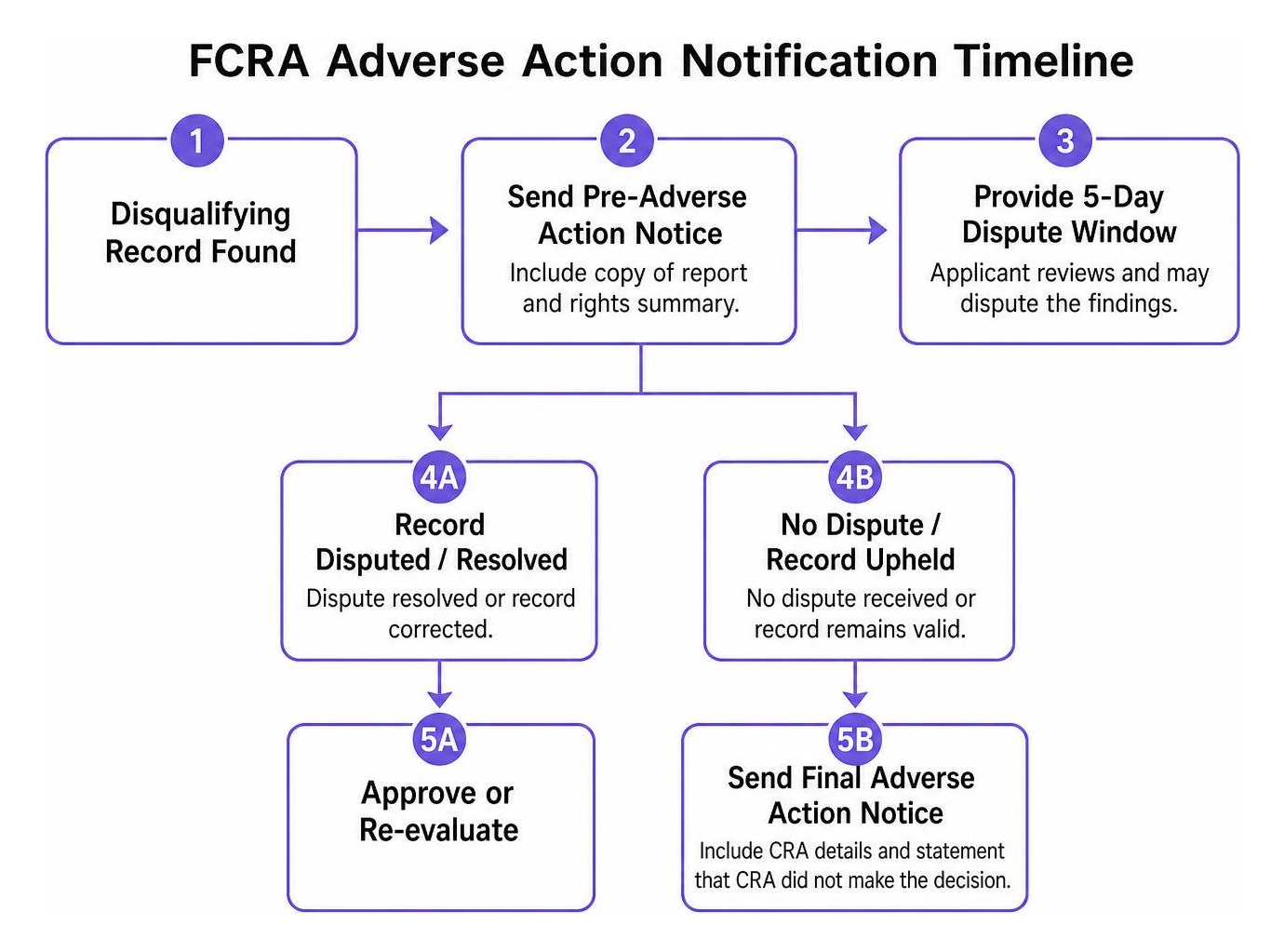
- Issue a Pre-Adverse Action Notice: Before finalizing any denial based in whole or in part on a consumer report, provide the applicant with a Pre-Adverse Action Notice. This packet must contain a complete copy of the background report and a written copy of the CFPB's "Summary of Your Rights Under the Fair Credit Reporting Act."
- Provide a Reasonable Dispute Window: Grant the applicant a reasonable window (typically five business days) to review the findings. This critical step allows applicants to identify mistaken identity, expunged records erroneously reported, or outdated disposition details.
- Send the Final Adverse Action Notice: If the applicant does not dispute the record or if the verified information still warrants a denial under your criteria, issue a formal Final Adverse Action Notice. This letter must state:
- The specific name, address, and toll-free telephone number of the CRA that furnished the report.
- A clear statement that the CRA did not make the rental decision and cannot explain why the application was declined.
- Notice of the applicant's right to obtain an additional free copy of their report within 60 days from the CRA.
- Notice of their right to dispute the accuracy or completeness of any data with the CRA directly.
Retain all screening documentation, notices, and audit timestamps securely for at least three to five years to ensure comprehensive compliance record retention.
Frequently Asked Questions About Tenant Criminal Checks
Can a landlord deny an applicant solely because of a past criminal conviction?
A landlord cannot enforce a blanket ban on all criminal convictions. Denying housing based on a conviction is legally defensible under Fair Housing Act standards only if the specific offense directly impacts the safety of residents or the security of the property. Housing providers must demonstrate a legitimate, non-discriminatory business necessity by weighing the nature, severity, and recency of the crime through an individualized assessment.
How far back can a tenant criminal background report look?
Under the FCRA (15 U.S.C. § 1681c), consumer reporting agencies are prohibited from reporting civil judgments, tax liens, and non-conviction arrest records older than seven years. While federal law permits the reporting of criminal convictions without a strict statutory lookback limit, many states and municipalities restrict conviction lookback windows to seven or ten years. Professional standards generally focus on records from the preceding seven years to balance safety with fair-chance principles.
What is the difference between an arrest record and a conviction in tenant screening?
An arrest record indicates only that law enforcement detained an individual upon suspicion of an offense; it does not establish guilt under the law. A conviction represents a formal court adjudication—such as a guilty verdict, a no-contest plea, or an entered plea bargain—confirming that the individual committed the crime. Under HUD guidance, an arrest cannot be used as an independent ground for rejecting a rental application.
Conclusion
Conducting tenant screening requires balancing property safety, cash flow protection, and strict adherence to federal and local housing laws. By implementing an objective, transparent workflow—relying on verified county-level court records, avoiding blanket bans, and following every step of the adverse action process—property owners protect their physical assets while treating all applicants equitably.
Managing compliance, screening verifications, and day-to-day operations across South Florida rental properties—from Aventura and Dania Beach to North Miami Beach and Miami—requires specialized expertise. Learn how our professional property management and tenant screening services deliver hands-on oversight, cutting-edge technology, and proven risk management for your rental portfolio. You can also explore our about page to see how we bring dedicated, boutique-style management to multi-unit and single-family properties throughout the region.
