
What Homeowners Association Management Services Do for Your Board

Homeowners association management services help a residential HOA board run the community without handling every daily task itself. A management company can coordinate meetings, track budgets and dues, oversee maintenance, inspect shared areas, keep records, and communicate with homeowners. The board still makes the decisions; the manager helps carry them out and keeps the board informed.
For busy board members, the value is clear: fewer tasks fall through the cracks, and owners have a clearer way to get updates and raise concerns. This guide explains what to expect from a manager, where the board remains responsible, and what to check before choosing a partner.
I’m Cédric Rose, founder and property manager at Management 305. Over more than 14 years in residential property operations, including community association management, I’ve learned that effective homeowners association management services pair hands-on follow-through with clear, timely information.
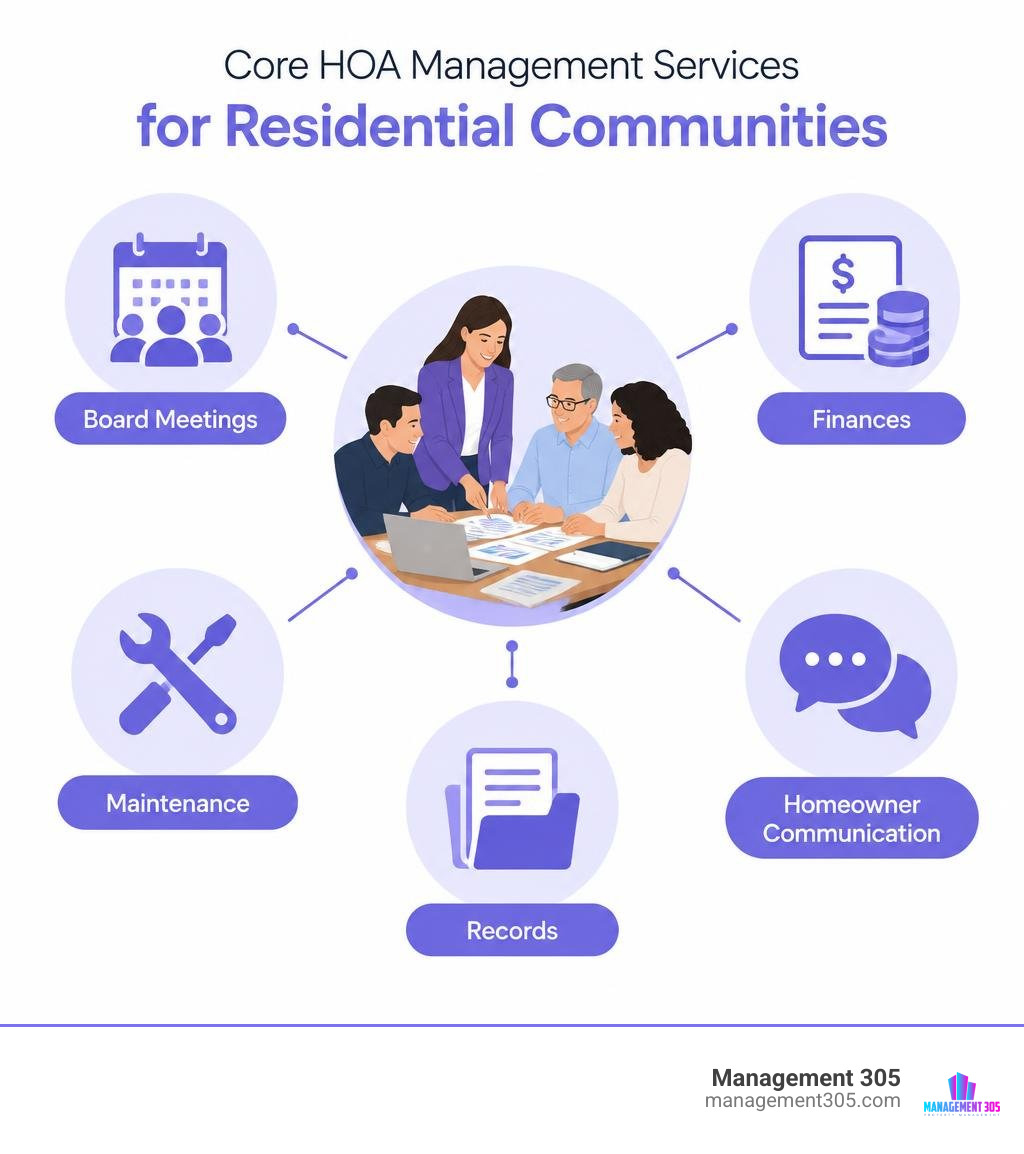
Core Homeowners Association Management Services for Residential Communities
Serving on a residential board means balancing legal fiduciary duties with neighborly relationships. When volunteer directors try to manage daily operations alone, burnout happens quickly. A licensed Community Association Manager (CAM) acts as an operational partner, turning board policy into daily execution while keeping the neighborhood aligned with Florida statutes and governing documents.
To understand how these daily responsibilities are structured, board members can review the core responsibilities of a community manager defined across the residential association sector.
Meeting Facilitation and Procedural Governance
A community association cannot function without structured, legally compliant meetings. When decisions occur outside proper parliamentary procedures, boards leave themselves open to legal challenges.
Professional management companies ensure that every meeting—from monthly sessions to annual elections—complies with statutory notice requirements and association bylaws. Management handles:
- Agenda and Board Packet Distribution: Drafting clear agendas, organizing supporting documentation, and delivering complete board packets well in advance so directors can make informed votes.
- Meeting Administration: Guiding discussions using proper parliamentary procedure, establishing voting quorums, and accurately recording official meeting minutes.
- Action Item Tracking: Converting board votes into actionable operational directives for vendors and administrative staff.
By establishing effective governance practices, management services protect volunteer directors from procedural missteps that create friction among homeowners.
Physical Property Inspections and Vendor Oversight
Preserving residential property values requires consistent, proactive maintenance. Managers conduct regular physical site walkthroughs to inspect shared amenities, landscaping, gates, building exteriors, and roadways.
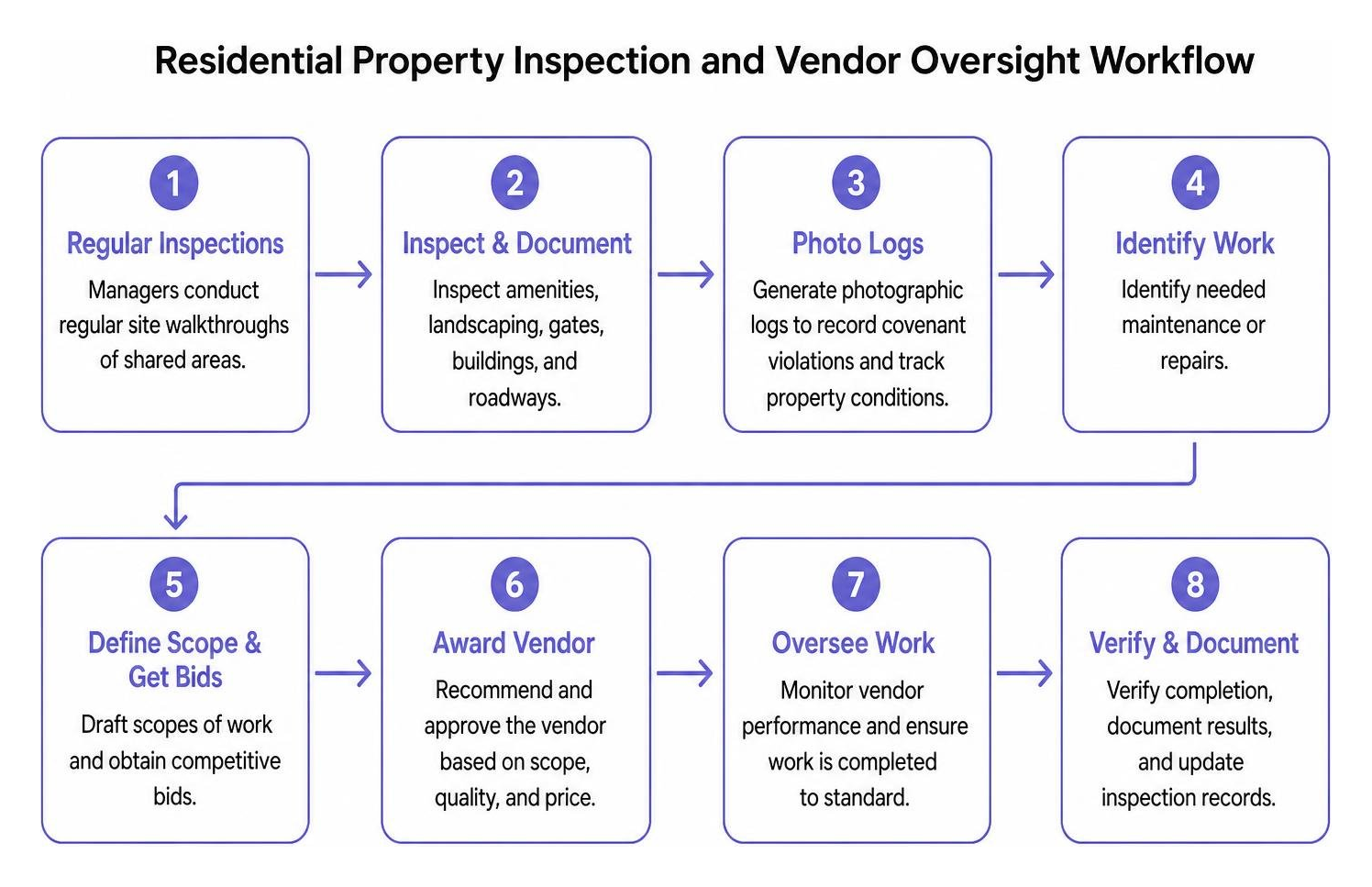
During these inspections, managers generate photographic logs to record covenant violations and track ongoing property conditions. This clear visual documentation ensures objective, consistent rule enforcement rather than subjective opinions.
When work is required, managers oversee third-party contractors by:
- Drafting detailed scopes of work and obtaining competitive bids.
- Verifying contractor licensing, general liability coverage, and workers' compensation insurance.
- Conducting post-service inspections to confirm work orders are fully completed before approving invoice payments.
For boards seeking comprehensive operational support, integrating these oversight capabilities alongside residential property management ensures neighborhood standards remain high year-round.
Financial Governance, Banking Security, and Document Administration
Sound financial management is the backbone of any healthy residential community. Mismanaged funds, underfunded reserves, and delayed collections can quickly lead to emergency special assessments.
Financial Planning and Reserve Accounting in Homeowners Association Management Services
Experienced management teams provide detailed accounting tailored to residential associations. This includes handling accounts payable and receivable, monthly balance sheets, income statements, and long-term reserve planning.
Long-range financial planning requires maintaining a realistic reserve schedule (often projecting 20 years into the future) to fund major capital repairs such as roofing replacements, road repaving, and pool resurfacing. Professional managers work directly with certified reserve specialists and independent CPAs to keep financial audits accurate and ensure your community complies with statutory reserve funding mandates.
| Financial Task | Self-Managed Board | Professionally Managed Community |
|---|---|---|
| Dues Collection | Inconsistent tracking, awkward peer collections | Automated digital portals and systematic delinquency notices |
| Financial Reporting | Manual spreadsheets with frequent lag | Real-time monthly balance sheets and income statements |
| Reserve Planning | Reactive special assessments during failures | Structured multi-year reserve schedules and CPA coordination |
| Invoice Approval | Ad-hoc checks without formal verification | Multi-tier approvals tied to completed inspection work orders |
Partnering with licensed experts for CAM community association management gives directors the financial transparency needed to make confident budgetary decisions.
Fund Security, Banking Protocols, and FDIC Insurance
Protecting community funds against fraud and institutional banking risk is a critical board duty. Association deposits must never be pooled with operating funds from other properties or treated casually.
Professional management protocols enforce strict safety measures:
- Account Segregation: Maintaining separate operating and reserve bank accounts titled directly in the association's legal name.
- FDIC Insurance Protection: Structuring deposits so association cash balances remain protected under Federal Deposit Insurance Corporation (FDIC) limits, often utilizing multi-bank sweep networks for large reserve holdings.
- Internal Controls: Requiring multi-signature authorizations, dual approvals for electronic fund transfers, and strict separation between the staff members who enter invoices and those who disburse funds.
Resale Disclosures, Lending Documents, and Fee Processing
Whenever a home in the community is sold or refinanced, lenders and title companies require official documentation to verify dues status, insurance policies, reserve levels, and pending litigation.
Management companies streamline this process by partnering with specialized platforms like CondoCerts to process resale disclosures, estoppel certificates, and lender questionnaires quickly. Digital document workflows reduce closing delays and provide buyers, sellers, and title agents with verified records.
Additionally, modern management systems offer homeowners clear options for recurring dues payments, including automated clearing house (ACH) transfers, credit cards, and digital eChecks, keeping delinquency rates low across the neighborhood.
Modern Communication Technology and Resident Relations
Clear communication prevents misunderstandings between boards and residents. When owners have quick access to community information, operational friction drops significantly.
Technology-Driven Homeowners Association Management Services and Communications
Modern management relies on integrated resident portals and mobile applications that provide instant access to association documents, account ledgers, and maintenance request tracking.
A critical tool for residential communities is emergency text messaging. While standard emails often sit unread in spam folders, urgent SMS broadcasts allow managers and board members to notify owners immediately about:
- Critical water main shutoffs or utility disruptions.
- Severe weather preparation instructions and gate closures.
- Urgent post-storm safety instructions.
Homeowners can easily opt in to these notification channels through their online profile settings, ensuring urgent updates reach every household. To see how digital systems streamline operations, explore our detailed community association management guide.
Community Engagement, Social Initiatives, and Architectural Reviews
A well-run community is more than balance sheets and rule enforcement—it is a neighborhood where people enjoy living. Management teams support this atmosphere by assisting Architectural Review Committees (ARC) with clear intake, tracking, and communication processes for modification requests.

By providing clear design guidelines, tracking homeowner submissions digitally, and issuing timely written decisions, management helps prevent architectural disputes. Managers can also assist boards with organizing community social events, informational town halls, and local charitable initiatives that build a welcoming neighborhood culture.
Frequently Asked Questions About Homeowners Association Management
Can homeowners legally opt out of a mandatory HOA?
No. Membership in a mandatory residential homeowners association runs with the land. When an owner purchases a home within a deed-restricted community, the requirement to belong to the association and abide by its covenants is tied directly to the property's title. An owner cannot opt out, withhold dues, or cancel their membership while owning the property.
Why do residents frequently challenge HOA board decisions?
Homeowners rarely challenge the board's intent; instead, they usually challenge the legality of the decision-making process. Common grounds for dispute include:
- Holding votes without proper advance notice to the community.
- Making decisions via private email chains rather than during open, noticed board meetings.
- Failing to establish a proper quorum before voting.
- Enforcing architectural or maintenance rules inconsistently across different owners.
Strict adherence to procedural bylaws and state statutes is the strongest defense against community legal challenges.
How do management companies secure association funds against bank failures?
Professional managers place association operating and reserve funds in reputable financial institutions covered by FDIC insurance. For associations with reserve balances that exceed standard individual account limits, managers implement automated multi-bank deposit placement services (such as ICS or CDARS). These networks distribute funds across multiple insured institutions while allowing the board to manage them through a single banking relationship.
Conclusion
Effective homeowners association management is built on partnership, transparency, and reliable execution. Volunteer board members should not have to spend their evenings chasing vendor invoices, drafting violation logs, or navigating complex banking rules alone.
At Management 305, we provide proactive, boutique-style residential community association management backed by real-time digital portals and hands-on operational support across South Florida, including Miami, Fort Lauderdale, Aventura, Sunny Isles Beach, Hollywood, Dania Beach, and North Miami Beach.
If your board is ready to bring consistency, financial clarity, and professional oversight to your residential community, connect with us at Management 305 to discuss customized management solutions for your neighborhood.
— Cédric Rose, Founder & Property Manager, Management 305
