
1. What Key Data Points Matter Most in Residential Tenant Screening?

Screening prospective renters requires a structured, data-driven approach to protect your property and ensure steady rental income. Effective residential vetting centers on an individual’s personal financial habits, rental track record, and legal background.
To protect residential investments across South Florida communities like Sunny Isles Beach, Miami, and Fort Lauderdale, landlords must examine a standard set of consumer reporting metrics. According to the Consumer Financial Protection Bureau, tenant screening reports may include credit history, eviction records, and criminal background information.
| Screening Data Point | Source / Report Type | What It Reveals | Risk Mitigation Value |
|---|---|---|---|
| Consumer Credit Score & History | Major Credit Bureaus (TransUnion, Experian, Equifax) | Detailed debt management, on-time payment habits, and total liabilities | Identifies overall financial reliability and debt management habits |
| Eviction History | Nationwide / County Court Records | Formal filings, judgments, and writ of possession history | Flags previous tenancy defaults and breach of lease agreements |
| Resident Risk Score | Proprietary algorithms (e.g., ResidentScore) | Specialized rental performance predictive modeling | Predicts lease default risk up to 15% better than generic credit scores |
| Criminal Background | Multi-jurisdictional & county databases | Public criminal records subject to local and federal limits | Enhances community safety while upholding fair housing standards |
| Income Verification | Direct bank connection or payroll records | True monthly earnings and direct deposit stability | Confirms the applicant earns sufficient income to meet the monthly rent |
| Public Records & Judgments | Civil court registries | Tax liens, open collections, and personal bankruptcy filings | Highlights unpaid obligations that could impact rent payments |
Understanding Consumer Resident Scores and Credit Reports
When evaluating prospective renters for residential properties, property owners rely on consumer reporting agencies that generate comprehensive credit histories and specialized rental risk scores. These tools provide an objective, in-depth view of an applicant's ability to maintain a lease.
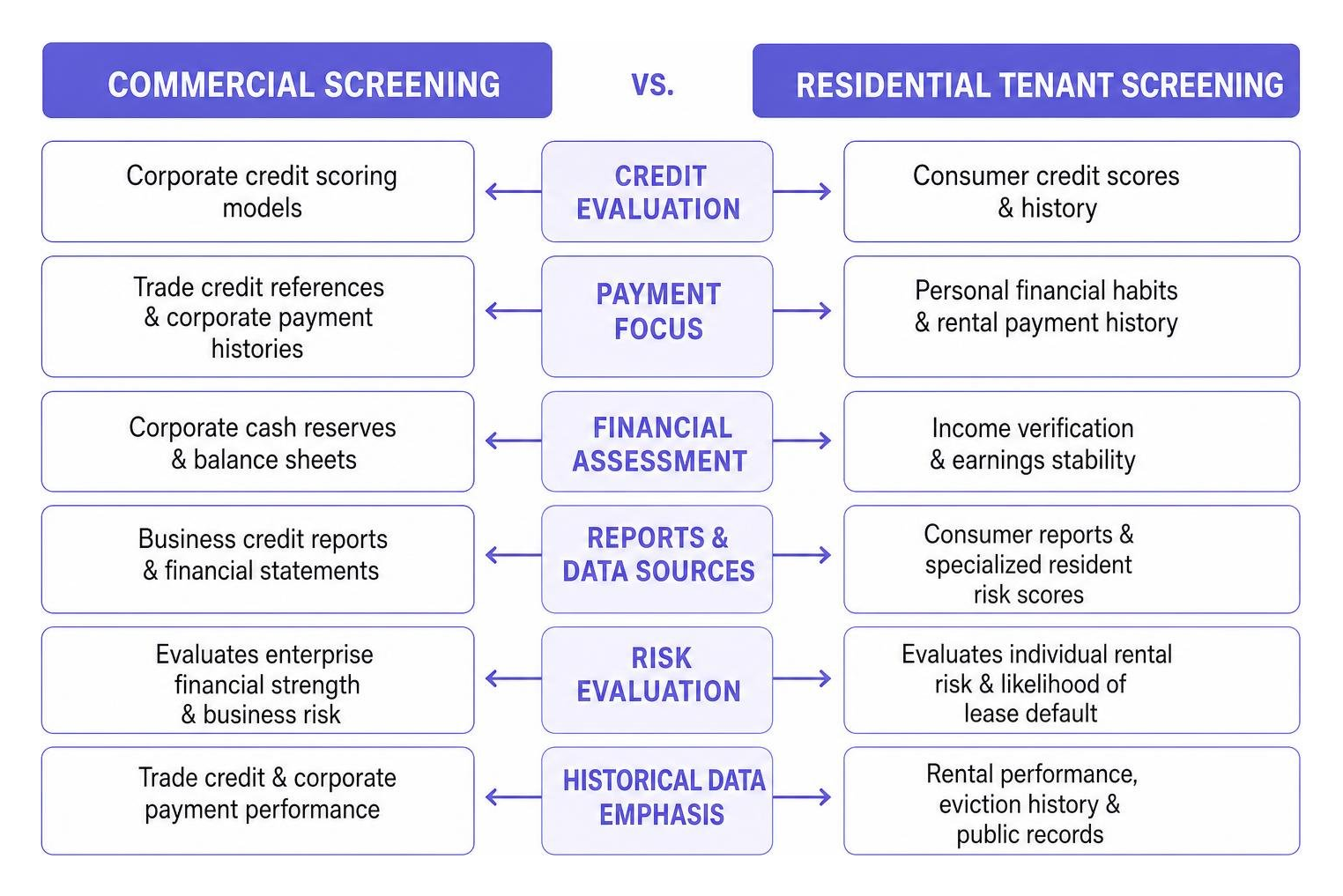
Consumer resident risk scores evaluate historical rental default data. A 2016 TransUnion study revealed that specialized resident risk scores predict rental eviction risk 15% better than traditional credit scores alone. While a standard credit score may drop because of student loans or medical bills, rental-focused scores isolate patterns—such as recurring late utility payments or residential collections—that correlate directly with lease non-compliance.
Evaluating Eviction Histories and Judgment Filings
Eviction filings and civil monetary judgments provide a clear window into an applicant's past rental performance. Eviction proceedings represent substantial financial and operational stress for any residential landlord; according to TransUnion survey data, the average cost of an eviction reaches $3,500 when factoring in legal filings, vacancy loss, and property turn costs.
A thorough residential screening search reviews county and multi-state public civil records for:
- Formal eviction petitions, pending hearings, and completed judgment orders.
- Civil money judgments arising from past unpaid rent, damages, or outstanding residential utilities.
- Past-due collections assigned to recovery agencies by former property managers or utility providers.
- Active and discharged personal bankruptcy filings (Chapter 7 and Chapter 13).
Reviewing these public records safeguards your residential asset from chronic non-payers while giving you an objective basis for every leasing decision.
2. How Do Screening Reports Address Identity Verification and Fraud Prevention?
Rental fraud has increased significantly alongside online applications. Sophisticated digital alteration tools allow bad actors to produce fabricated pay stubs, alter bank statements, and use synthetic identities to bypass basic manual checks.
Modern residential screening platforms counteract these risks by implementing biometric identity validation, multi-factor applicant authentication, and live database matching. When coordinating tenant placement through our residential real estate services, pairing automated ID verification with detailed in-person showings ensures that the person moving into your home is exactly who they claim to be.
Mitigating Application Fraud with Bank-Verified Income Data
Relying solely on uploaded PDF pay stubs or manually generated employer letters leaves landlords vulnerable to document manipulation. Leading screening technology now connects directly to financial institutions via secure credentialing platforms to access real-time, bank-verified income data.
Direct bank verification provides undeniable benefits:
- Tamper-Proof Verification: Directly pulls net deposits and payroll records from the applicant’s banking institution.
- Cash Flow Tracking: Accurately calculates recurring monthly earnings, average daily balances, and non-sufficient funds (NSF) occurrences.
- Speed: Delivers verified payroll insights within minutes, cutting application review timelines and reducing vacancy periods.
Why Landlords May Check Guarantors and Other Lease Signers
When a prospective tenant presents borderline qualifications—such as a limited credit file, recent career transition, or self-employment status—residential landlords often require a lease guarantor or co-signer.
Guarantors must undergo the exact same rigorous screening process as primary applicants. Because the guarantor signs an agreement assuming full financial liability for rent, damages, and lease defaults, evaluating their consumer credit, liquid cash reserves, and public records is essential before executing the lease agreement.
3. What Legal Compliance Rules Apply Under FCRA and Fair Housing Regulations?
Screening residential tenants requires strict adherence to federal, state, and municipal regulations. The Fair Credit Reporting Act (FCRA) and the Fair Housing Act govern every stage of the evaluation process, establishing standards for data collection, adverse decisions, and non-discriminatory qualification criteria.

Professional management requires total regulatory diligence. Our team at Management 305 delivers full-service property management that keeps every application, notice, and screening workflow fully compliant with Florida landlord-tenant statutes and federal standards.
Automated Adverse Action Notices and Federal Standards
Under the FCRA, if an applicant is rejected, required to pay an increased security deposit, or asked to provide a co-signer based on information in a consumer report, the landlord must issue a formal Adverse Action Notice.
Failing to issue timely adverse action documentation can expose landlords to statutory damages and legal liabilities. A compliant adverse action notice must contain:
- The exact name, physical address, and toll-free telephone number of the consumer reporting agency that furnished the report.
- A formal statement clarifying that the credit reporting agency did not make the final rental decision and cannot explain the specific reasons for denial.
- Notice of the applicant's legal right to request a free copy of their consumer file from the reporting agency within 60 days.
- Information detailing the applicant's right to dispute inaccurate or incomplete information directly with the bureau.
Applying Residential Screening Rules to Lease Guarantees
Residential consumer protections apply equally to lease guarantors. When evaluating a guarantor's consumer credit report, you must obtain prior written consent and follow the same non-discriminatory criteria used for primary applicants.
Landlords cannot selectively alter qualification thresholds or demand higher deposits based on protected characteristics like race, color, national origin, religion, sex, familial status, or disability. Establishing clear, uniform written criteria across all residential properties ensures fair housing compliance.
4. What Are the Critical Financial Red Flags in Tenant Screening Reports?
Identifying subtle warning signs early protects your cash flow and maintains your property’s investment value across North Miami Beach, Aventura, and Hollywood neighborhoods.

A comprehensive screening package allows you to evaluate specific financial patterns rather than relying on gut feelings.
Credit Utilization Ratios and Prior Default Filings
An applicant’s overall credit score doesn't always tell the whole story. A tenant might maintain a moderate score while carrying significant revolving debt balances that stretch their monthly budget to the limit.
- Revolving Credit Utilization: High utilization rates (consistently carrying credit card balances above 50% to 80% of available limits) suggest an applicant may be living beyond their means.
- Recent Delinquencies: Consecutive 30-, 60-, or 90-day late payment markers across open trade lines point to immediate cash-flow instability.
- Auto or Personal Loan Defaults: Repossessions or charged-off accounts reveal an inability to manage major recurring installment obligations.
- Recent Tax Liens or Civil Judgments: Unresolved monetary liabilities take legal priority over personal expenses and can result in sudden wage garnishments.
Income-to-Rent Ratios and Security Deposit Handling
A reliable rule of thumb across residential leasing is requiring an applicant's verifiable gross monthly income to equal at least 2.5 to 3 times the monthly rent. If an applicant spends more than 35% to 40% of their gross earnings on rent, unexpected expenses can quickly lead to payment delays.
When financial qualifications fall just below standard criteria, collecting an adjusted security deposit can provide an added risk cushion where permitted. In Florida, security deposits must be handled in strict compliance with state law—held in a dedicated Florida banking institution with mandatory written disclosures provided to the tenant detailing where and how their funds are held.
Frequently Asked Questions About Tenant Background Checks
Who typically pays for the tenant screening background check?
In most residential leasing transactions across South Florida, the prospective tenant pays the application fee directly when submitting their screening authorization. This fee covers the hard cost of credit bureau pulls, nationwide criminal database searches, and digital income verification. Some independent property owners choose to absorb this fee for competitive listings, but tenant-paid screening remains standard.
How quickly are residential background and credit reports delivered?
Modern screening platforms generate automated credit, identity, and criminal background reports within minutes of applicant authorization. However, turnaround times can take 24 to 48 hours if manual courthouse record searches are required in specific counties or if previous landlords and employers must be contacted directly by phone.
Can screening predict eviction risks better than standard credit scores?
Yes. Generic credit scoring models evaluate general consumer creditworthiness for revolving credit cards and installment loans. Specialized resident scoring algorithms specifically weigh past rental payment histories, residential collections, lease breaks, and local eviction filings. These predictive rental models forecast lease default risk up to 15% better than standard FICO scores.
Conclusion
Securing reliable, respectful, and financially capable tenants is the foundation of successful residential real estate investment. A thorough screening process—combining verified consumer credit, predictive resident scores, multi-jurisdictional eviction histories, and direct bank income verification—protects your cash flow and preserves long-term property value.
Navigating compliance requirements, marketing vacancies on MLS systems, vetting applicants, and managing day-to-day property maintenance requires dedicated oversight. If you are seeking seamless, transparent management for your private residential property or residential community, explore our Management 305 professional management services to see how our hands-on team can support your investment goals across South Florida. For tailored property strategies, you can contact us directly or read more industry insights on our blog.
