
The Complete Guide to Residential Tenant Background Checks
Residential Tenant Screening: Key Differences and Requirements

A residential tenant background check requires evaluating identity, credit, income verification, and rental or court records to determine whether an applicant can reliably meet lease obligations. While a commercial lease tenant background check may focus on corporate balance sheets and trade references, residential screening centers entirely on the individual applicant and their household.
Lease terms in residential real estate typically run for 12-month periods, with options for annual renewal. Because residential tenancies represent immediate housing needs, turnover cycles are frequent, and assessing personal character, household stability, and dependable income is paramount.
When managing rental units across South Florida communities—from Sunny Isles Beach to Fort Lauderdale—implementing structured, objective evaluation criteria protects both the property's financial performance and community safety. Professional residential and multi-unit property management balances robust screening tools with empathetic, fair customer service.
| Screening Dimension | Low-Risk Profile | Moderate-Risk Profile | Elevated-Risk Profile |
|---|---|---|---|
| Credit History | Established tradelines, on-time payments, no recent collections | Minor past late payments, low revolving debt balances | Active collections, unresolved utility debt, recent charge-offs |
| Income Verification | Verifiable income exceeding 2.5x to 3x monthly rent | Income near minimum threshold, variable gig-economy earnings | Unverifiable income, significant income gaps, uncorroborated documents |
| Rental History | 2+ years of verified on-time rent from independent landlords | First-time renter or limited formal leasing history | Prior eviction judgments, broken leases, negative landlord references |
| Public Records | Clean background check, valid government ID matching records | Minor civil disputes unconnected to tenancy | Prior tenancy-related judgments, falsified identity details |
Assessing Rental Readiness and Tenant History
Assessing rental readiness goes beyond checking whether an applicant has enough cash in the bank for the first month's rent. It requires looking at how reliably they manage ongoing commitments.
We evaluate income stability by examining steady employment, reliable retirement distributions, or other documented, consistent income sources. Cross-referencing current pay stubs or bank deposits helps verify that earnings are regular and predictable.
Rental history gives valuable insight into how an applicant respects lease agreements and shared spaces. Speaking with prior independent property owners provides context on whether rent arrived on time, how well the home was maintained, and whether the applicant respected community policies and neighbors.
Financial Scope and Lease-Term Risks
In residential leasing, rent payments rely directly on household cash flow. If a tenant experiences a sudden loss of income or encounters unexpected personal expenses, the landlord faces immediate financial disruption.
Unlike commercial leases, which often involve corporate assets or institutional backing, residential leases depend on individual earning capacity. When rent is missed, the costs of missed mortgage payments, maintenance, and potential legal fees can accumulate quickly.
Properly structuring security deposits within Florida statutory guidelines, ensuring clear move-in cost requirements, and requiring full upfront settlement of first month's rent and security deposits before key handover safeguard property investments.
Essential Components of a Residential Tenant Background Check
A comprehensive residential background check combines several data points to build a clear profile of an applicant's reliability. Rather than looking at any single metric in isolation, reviewing records across credit, identity, rental history, and legal public records provides a balanced evaluation.
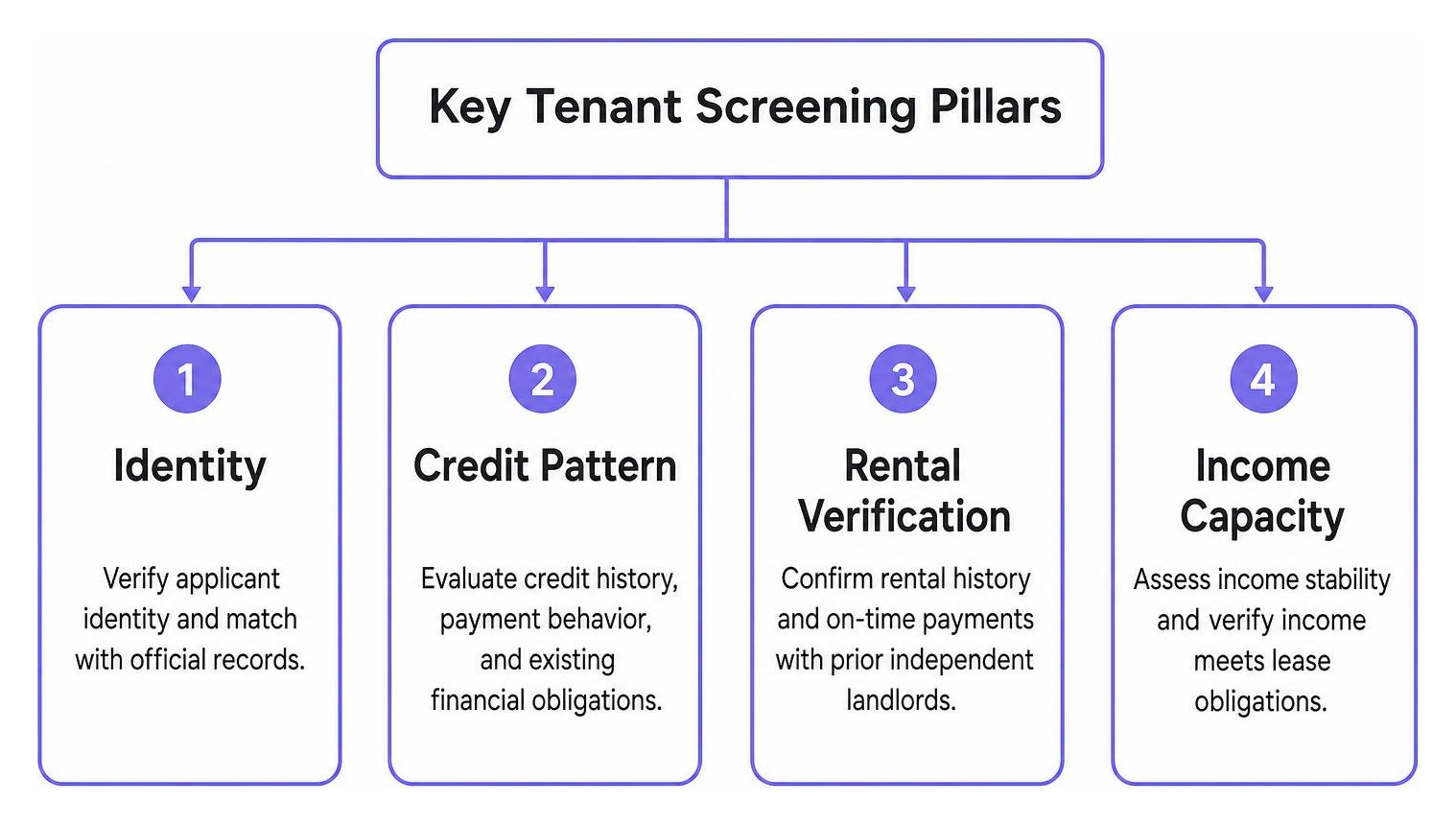
| Screening Component | Standard Data Points Reviewed | Risk Indicators to Investigate |
|---|---|---|
| Credit Evaluation | Tradeline history, debt-to-income indicators, auto and loan payments | Habitual 30/60/90-day late payments, recent repossessions |
| Public Records & Courts | Civil court judgments, verified eviction records, identity validation | Unresolved monetary judgments from prior housing providers |
| Rental Verification | Payment ledger history, lease compliance, notice given properly | Reluctance to provide previous landlord contact, sudden move-outs |
| Income & Employment | Pay statements, W-2 forms, tax returns, bank asset records | Heavy document alterations, mismatched employer details |
Credit Scores and Payment History
When reviewing a credit report, looking beyond the three-digit credit score reveals the true story of an applicant's financial habits. Credit scores can fluctuate due to medical bills or student loans, which may not directly indicate how an individual treats their monthly housing obligation.
Examine the tradeline patterns carefully. Has the applicant consistently paid housing, auto loans, and utility providers on time? A tenant who maintains an average credit score but boasts a spotless history of on-time utility and auto payments often presents a lower leasing risk than someone with a high score who routinely pays essential bills weeks late.
Look out for unresolved balances owed to property management companies, housing providers, or utility companies, as these debts directly reflect residential tenancy obligations.
Identity, Rental History, and Public Records
Validating identity is the foundation of the entire background check process. Review government-issued identification—such as a driver's license or passport—to ensure personal details match the lease application and credit file exactly.
Next, examine public records for civil judgments, specifically focusing on verified eviction judgments. An eviction filing that was dismissed or resolved without judgment requires context, whereas an active, unfulfilled monetary judgment from a previous landlord signals a clear financial risk.
Directly contacting past housing providers to confirm dates of residency, rent amounts, payment punctuality, and property condition at move-out confirms whether self-reported application details match reality.
Income, Co-Signers, and Guarantors
Verifying gross household income ensures that the rent remains affordable throughout the lease term without placing undue financial strain on the resident. A standard residential affordability benchmark requires verifiable gross monthly income equal to approximately 2.5 to 3 times the monthly rent.
For applicants who fall slightly below the required income threshold—such as full-time students, recent college graduates, or individuals transitioning careers—adding a qualified co-signer or lease guarantor can provide financial security.
A guarantor must undergo the same rigorous credit and identity screening process, demonstrating sufficient financial reserves and a strong credit score (typically 700 or higher) to cover the lease commitments if the primary tenant defaults.
How to Conduct Due Diligence on New Applicants and Higher-Risk Applications

Document fraud is a growing challenge in the property management industry. Industry research indicates that up to 84% of landlords have encountered fraudulent applicant documentation, ranging from altered pay stubs and forged bank statements to fabricated landlord references.
Following a structured verification process protects your properties from professional scammers while ensuring qualified applicants are evaluated fairly. Reviewing a guide to tenant screening best practices reinforces the importance of structured verification workflows.
How to Screen Applicants With Limited Rental History
First-time renters, international professionals relocating to the area, and young adults entering the rental market naturally lack extensive credit or residential histories. Having a thin file does not automatically make someone a poor tenant; it simply means standard evaluation tools provide less historical data.
To properly screen applicants with limited rental histories:
- Request alternative financial verification, such as consecutive months of verified bank statements showing steady asset reserves.
- Verify employment stability by speaking directly with HR departments or obtaining official offer letters that detail starting salaries and start dates.
- Request personal or professional references from employers, professors, or supervisors who can speak to the applicant's reliability and character.
- Consider utilizing a qualified guarantor or adjusting the security deposit within state-regulated limits to balance the portfolio's risk.
Spotting Red Flags in Credit Reports and Rental History
Careful due diligence helps you identify inconsistencies before signing a binding lease agreement. Key warning signs during the review include:
- Unresolved Landlord Collections: Outstanding balances owed to previous management firms or utility providers.
- Inconsistent Application Details: Discrepancies between the addresses listed on credit reports, pay stubs, and the rental application form.
- Rushed Move-In Timelines: An urgent demand to move in immediately without a clear, valid reason (which can indicate an ongoing eviction at a current residence).
- Reluctance to Provide Standard Documents: Pushback when asked for standard identification, tax records, or direct employer contact information.
- Suspicious Landlord Contact Details: Reference phone numbers that connect to personal mobile lines where the contact cannot answer basic questions about the property address or lease term.
Legal Framework and Risk Mitigation Strategies
Screening tenants requires strict adherence to federal, state, and local legal standards. Landlords must balance effective risk management with consumer privacy and anti-discrimination laws.
Operating rental properties in South Florida markets—such as Miami, Hollywood, Dania Beach, and Aventura—requires establishing written, standardized screening criteria applied equally to every applicant. Partnering with a brokerage providing professional real estate services helps keep leasing operations compliant with evolving statutory frameworks.
Legal Compliance Rules for Residential Tenant Background Checks
Residential background checks are governed by several key pieces of consumer protection legislation:
- Fair Credit Reporting Act (FCRA): You must obtain clear, written consent from the applicant before ordering consumer credit reports or investigative background checks. The data obtained must be handled securely and disposed of properly to protect sensitive personal information.
- Fair Housing Protections: Under the federal Fair Housing Act and local ordinances, housing providers cannot discriminate based on race, color, national origin, religion, sex, familial status, or disability. All screening thresholds—such as required credit scores, income-to-rent ratios, and reference verifications—must be applied consistently across all applicants.
- Criminal Record Evaluation: In line with HUD guidance, blanket policies that reject any applicant with an arrest record are legally problematic. Landlords should conduct individualized assessments that evaluate the nature, severity, and time elapsed since any criminal conviction, considering its direct relevance to property safety and community well-being.
Navigating Adverse Action and Denial Procedures
If you take adverse action against an applicant based in whole or in part on information contained in a consumer report, the FCRA requires you to provide a formal Adverse Action Notice. Adverse action includes denying an application, requiring a co-signer, or requesting an increased security deposit.
The adverse action notice must be delivered in writing and contain:
- The name, address, and toll-free telephone number of the consumer reporting agency that supplied the report.
- A clear statement that the reporting agency did not make the leasing decision and cannot explain why the application was denied.
- Notice of the applicant's right to obtain a free copy of their consumer report from the agency within 60 days.
- Notice of the applicant's right to dispute the accuracy or completeness of any information in the report directly with the credit bureau.
Frequently Asked Questions about Residential Tenant Screening
How long does a residential tenant background check typically take?
A residential background check usually takes between 24 to 72 hours, though comprehensive evaluations can take up to a week if there are delays in third-party verifications. Automated credit and identity checks return results almost instantly.
The primary factor determining processing time is the responsiveness of employers and previous landlords when verifying employment details and past rental performance. Providing complete, accurate contact details on the initial application helps expedite the turnaround.
What credit score is required for a residential rental approval?
There is no universal credit score cutoff for residential rentals. While many property managers look for a credit score of 620 to 650 or higher as a baseline for standard approval, individual scores are evaluated within the context of the entire application.
Landlords look closely at debt utilization, monthly income stability, and on-time rent payment histories. An applicant with a lower score caused by past student loan debt who has spotless rent and utility payment records is often approved with standard terms or an additional security deposit.
Can a landlord deny a residential applicant based on rental or credit history?
Yes. Property owners have the legal right to decline an applicant based on legitimate, non-discriminatory business criteria, such as insufficient verifiable income, poor credit repayment history, active collections from utility providers, or prior verified eviction judgments.
To remain compliant with fair housing laws, the landlord must apply the exact same evaluation criteria to all applicants and issue a formal Adverse Action Notice whenever consumer report data contributes to the rejection.
Conclusion
A well-structured tenant screening workflow protects your residential property, preserves steady cash flow, and creates positive, long-term relationships across your community. By looking beyond raw numbers to review overall payment patterns, verifying income directly, and adhering strictly to fair housing and FCRA guidelines, you safeguard your real estate investments against unnecessary financial disruptions.
At Management 305, we deliver end-to-end residential property management throughout South Florida—serving owners in Sunny Isles Beach, Miami, Dania Beach, Hollywood, North Miami Beach, and Fort Lauderdale. Our hands-on team combines modern owner and tenant portals with proactive oversight to handle everything from rigorous tenant screening and Florida-compliant lease execution to preventative maintenance and financial reporting.
Explore our comprehensive leasing and management services to discover how we simplify residential ownership and protect your property's long-term value.